Advertisements
Advertisements
Question
In the quadrilateral PQRS, PQ is the smallest side and SR is the longest side. Prove that ∠P > ∠R and ∠Q > ∠S.
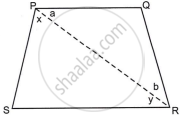
[Hint: Join PR, prove that x > y and a > b. ∴ x + a > y + b, etc.]
Advertisements
Solution
Given
In quadrilateral PQRS:
- PQ is the smallest side,
- SR is the longest side.
To prove: ∠P > ∠R and ∠Q > ∠S.
1) Prove ∠P > ∠R
Join the diagonal PR.
- In ΔPQR, let ∠QPR = x and ∠PRQ = y.
Since PQ is the smallest side, the angle opposite it is the smallest angle of ΔPQR.
Opposite PQ is ∠PRQ = y.
Hence x > y. - In ΔPRS, let ∠RPS = a and ∠PRS = b.
Since SR is the longest side, the angle opposite it is the largest angle of ΔPRS.
Opposite SR is ∠RPS = a.
Hence a > b.
Now the interior angles at P and R of the quadrilateral are:
∠P = ∠QPR + ∠RPS = x + a,
∠R = ∠PRQ + ∠PRS = y + b.
Since x > y and a > b, we get x + a > y + b.
Thus ∠P > ∠R.
2) Prove ∠Q > ∠S
Now join the other diagonal QS.
- In ΔPQS, denote ∠PQS = u and ∠QSP = v.
Here PQ is still the smallest side, so the angle opposite PQ it is the smallest angle of ΔPQS.
Opposite PQ is ∠QSP = v.
Hence u > v. - In ΔQRS, denote ∠RQS = m and ∠QSR = n.
Here SR is the longest side, so the angle opposite SR is the largest angle of ΔQRS.
Opposite SR is ∠RQS = m.
Hence m > n.
The interior angles at Q and S of the quadrilateral are:
∠Q = ∠PQS + ∠RQS = u + m,
∠S = ∠QSP + ∠QSR = v + n.
Since u > v and m > n, we get u + m > v + n.
Thus, ∠Q > ∠S.
Therefore, using the “greater side ↔ greater opposite angle” fact in the two triangles formed by each diagonal, we conclude:
∠P > ∠R and ∠Q > ∠S
