Advertisements
Advertisements
Question
In the given graph ABCD is a parallelogram.
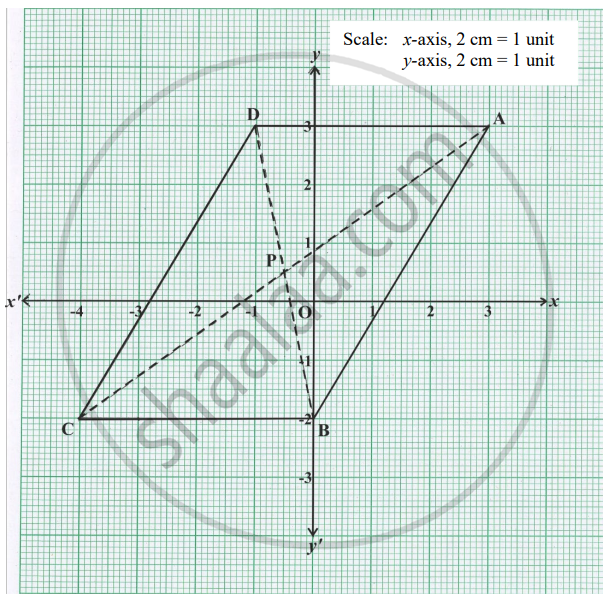
Using the graph, answer the following:
- write down the coordinates of A, B, C and D.
- calculate the coordinates of ‘P’, the point of intersection of the diagonals AC and BD.
- find the slope of sides CB and DA and verify that they represent parallel lines.
- find the equation of the diagonal AC.
Advertisements
Solution
(a) From the graph, the coordinates of the points are:
A = (3, 3),
B = (0, −2),
C = (−4, −2),
D = (−1, 3).
(b) Since point P is the midpoint of both diagonals AC and BD:
For diagonal AC, with A(3, 3) and C(−4, −2), the midpoint is calculated as:
P = `((3 + (−4))/2, (3 + (−2))/2) = (−1/2, 1/2)`
For diagonal BD, with B(0, −2) and D(−1, 3), the midpoint is:
P = `((0 + (−1))/2, (−2 + 3)/2) = (−1/2, 1/2)`
Thus, the diagonals intersect at the same midpoint.
(c) To find the slope of side CB, using points C(−4, −2) and B(0, −2):
`m_1 = (− 2 + 2)/(0 + 4) = 0`
To find the slope of side DA, using points D(−1, 3) and A(3, 3):
`m_2 = (3 − 3)/(3 + 1) = 0`
Since m1 = m2, sides CB and DA are parallel. Hence verified.
(d) To find the equation of diagonal AC, using points A(3, 3) and C(−4, −2):
First, calculate the slope:
m = `(−2 −3)/(−4 −3) = 5/7`
Using the point-slope form:
`y − 3 = 5/7 (x − 3)`
Simplifying, we get:
`y = 5/7x − 43/7`
7y − 5x + 43 = 0
