Advertisements
Advertisements
Question
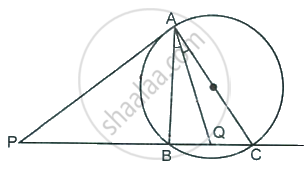
In the given figure, PA is a tangent to the circie and PBC is a secant. AQ is the bisector of ∠BAC. Show that ΔPAQ is an isosceles triangle. Also show that: ∠CAQ = `1/2` (∠PBA− ∠PAB).
Advertisements
Solution
Given:
PA is a tangent to the circle.
PBC is a secant.
AQ is the bisector of ∠BAC.
ΔPAQ is an isosceles triangle.
∠CAQ = `1/2` ( ∠PBA − ∠PAB ).
To prove ΔPAQ is isosceles
Step 1: Use the tangent–chord theorem
PA is tangent at A, and AB is a chord.
So,
∠PAB = ∠ACB …(1)
Similarly, AC is a chord, so
∠PAC = ∠ABC …(2)
Step 2: Use angle bisector AQ.
AQ bisects ∠BAC:
∠BAQ = ∠QAC …(3)
Step 3: Combine results
From (1) and (2):
∠PAB + ∠PAC = ∠ACB + ∠ABC = ∠ABC + ∠ACB = ∠BAC
Since AQ bisects ∠BAC
∠PAQ = ∠QAP
Hence,
ΔPAQ has two equal angles → PA = PQ
ΔPAQ is isosceles.
To show
∠CAQ = `1/2` (∠PBA − ∠PAB)
Step 1: Express ∠PBA
∠PBA = ∠PBC − ∠ABC
But ∠PBC is an external angle at B, so keep as is.
Step 2: Replace ∠ABC using the tangent-chord theorem.
∠PAC = ∠ABC
⇒ ∠ABC = ∠PAC
So, ∠PBA = ∠PBC − ∠PAC …(4)
Step 3: Use the angle bisector
AQ bisects ∠BAC:
∠CAQ = `1/2` ∠BAC …(5)
Now,
∠BAC = ∠PAB + ∠PAC
Substitute into (5):
∠CAQ = 1/2 (∠PAB + ∠PAC) …(6)
Step 4: Substitute ∠PAC from (4)
∠PAC = ∠PBC − ∠PBA
Put this in (6):
∠CAQ
= `1/2` ∠PAB + ∠PBC − ∠PBA
But ∠PBC cancels because PBC is a straight line extension of PB:
∠PBC = 180° − ∠PBA
Final simplified form:
∠CAQ = `1/2` (∠PBA − ∠PAB)
