Advertisements
Advertisements
Question
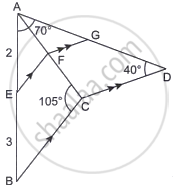
In the given figure(not drawn to scale), BC is parallel to EF, CD is parallel to FG, AE : EB = 2 : 3, ∠BAD = 70°, ∠ACB = 105°, ∠ADC = 40° and AC is bisector of ∠BAD.
- Prove ΔAEF ~ ΔAGF
- Find:
- AG : AD
- area of ΔACB : area ΔACD
- area of quadrilateral ABCD : area of ΔАСВ.
Advertisements
Solution
Given:
BC || EF, CD || FG.
AE : EB = 2 : 3.
∠BAD = 70°, ∠ACB = 105°, ∠ADC = 40°.
AC is the bisector of ∠BAD, so ∠BAC = ∠CAD = 35°.
Step-wise calculation:
1. From AC bisecting ∠BAD:
∠BAC = ∠CAD
= `70^circ/2`
= 35°
2. In ΔABC:
∠ABC = 180° – ∠BAC – ∠ACB
= 180° – 35° – 105°
= 40°
3. Using the parallels:
EF || BC
⇒ ∠AEF = ∠ABC = 40°
FG || CD
⇒ ∠AGF = ∠ADC = 40°
At A, ∠EAF = ∠GAF = 35°, each is the angle between `(AE)/(AG)` and AC.
Hence, ΔAEF and ΔAGF have two equal angles 35° and 40° and so are similar AA. This proves part (a).
4. For AG : AD:
EF || BC
⇒ ΔAEF ∼ ΔABC
So, `(AF)/(AC) = (AE)/(AB)`.
AE : EB = 2 : 3
⇒ `(AE)/(AB) = 2/(2 + 3) = 2/5`
So, `(AF)/(AC) = 2/5`.
From similarity in step 3 (ΔAGF ∼ ΔADC),
`(AG)/(AD) = (AF)/(AC) = 2/5`
Therefore, AG : AD = 2 : 5.
5. For area(ΔACB) : area(ΔACD):
In ΔACD:
∠CAD = 35°
∠ADC = 40°
So, ∠ACD = 180° – 35° – 40° = 105°.
Thus, ΔACB and ΔACD have angles (35°, 105°, 40°) in common and they share side AC.
By ASA they are congruent, so their areas are equal.
Therefore, area(ΔACB) : area(ΔACD) = 1 : 1.
6. For area(quadrilateral ABCD) : area(ΔACB):
Quadrilateral ABCD is the union of ΔACB and ΔACD, which have equal area.
So, area(ABCD) = 2 × area(ΔACB).
Therefore, area(ABCD) : area(ΔACB) = 2 : 1.
