Advertisements
Advertisements
Question
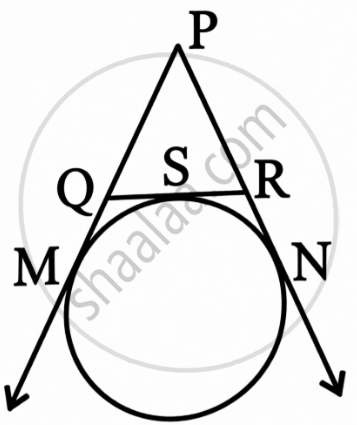
In the given figure, if a circle touches the side QR of Δ PQR at S and extended sides PQ and PR at M and N respectively, then prove that:
PM = `1/2` (PQ + QR + PR)
Advertisements
Solution
Given: PM, PN, QR are tangents.
Length of tangent from external point to a circle is equal:
PM = PN ...(i)
QM = QS ...(ii)
RN = RS ...(iii)
The perimeter of the triangle is the sum of its three sides:
Perimeter = PQ + QR + PR
Since the point S lies on QR,
QR = QS + SR ...(iv)
The point S lies on Q, PM,
PM = PQ + QM ...(v)
The point S lies on R, PN,
PN = PR + RN ...(vi)
RHS = `1/2` [PQ + QR + PR]
= `1/2`[PQ + QS + SR + PR] ...[Using equation (iv)]
= `1/2`[PQ + QM + RN + PR] ...[Using equations (ii) and (iii)]
= `1/2`[PM + PN] ...[Using equations (v) and (vi)]
= `1/2` [PM + PM] ...[Using equation (i)]
= `1/2 xx 2 PM`
= PM
= LHS.
Hence proved.
