Advertisements
Advertisements
Question
In the following table, a ratio is given in each column. Find the remaining two ratios in the column and complete the table.
| sin θ | `11/61` | `1/2` | `3/5` | ||||||
| cos θ | `35/37` | `1/sqrt3` | |||||||
| tan θ | `1` | `21/20` | `8/15` | `1/(2sqrt2)` |
Advertisements
Solution
| sin θ | `bb(12/37)` | `11/61` | `bb(1/sqrt2)` | `1/2` | `bb(sqrt2/sqrt3)` | `bb(21/29)` | `bb(8/17)` | `3/5` | `bb(1/3)` |
| cos θ | `35/37` | `bb(60/61)` | `bb(1/sqrt2)` | `bb(sqrt3/2)` | `1/sqrt3` | `bb(20/29)` | `bb(15/17)` | `bb(4/5)` | `bb((2sqrt2)/3)` |
| tan θ | `bb(12/35)` | `bb(11/60)` | 1 | `bb(1/sqrt3)` | `bb(sqrt2)` | `21/20` | `8/15` | `bb(3/4)` | `1/(2sqrt2)` |
Explanation:
(i) cos θ = `35/37` ...(i)[Given]
In right angled ΔABC,
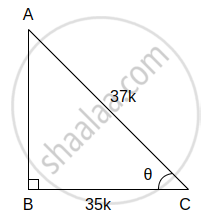
∠C = θ
cos θ = `"Adjacent side of θ"/"Hypotenuse"`
∴ cos θ = `"BC"/"AC"` ...(ii)
∴ `"BC"/"AC" = 35/37` ...[From (i) and (ii)]
Let the common multiple be k.
∴ BC = 35k and AC = 37k
Now, AC2 = AB2 + BC2 ...[Pythagoras theorem]
∴ (37k)2 = AB2 + (35k)2
1369k2 = AB2 + 1225k2
AB2 = 1369k2 – 1225k2
AB2 = 144k2
AB2 = (12k)2
Taking square root of both sides,
AB = 12k
∴ sin θ = `"Opposite side of θ"/"Hypotenuse" = "AB"/"AC" = "12k"/"37k" = 12/37`.
tan θ = `"Opposite side of θ"/"Adjacent side of θ" = "AB"/"BC" = "12k"/"35k" = 12/35`.
(ii) sin θ = `11/61` ...(i)[Given]
In right angled ΔABC, ∠C = θ
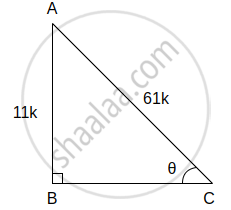
sin θ = `"Opposite side of θ"/"Hypotenuse"`
∴ sin θ = `"AB"/"AC"` ...(ii)
∴ `"AB"/"AC" = 11/61` ...[From (i) and (ii)]
Let the common multiple be k.
AB = 11k and AC = 61k
Now, AC2 = AB2 + BC2 ...[Pythagoras theorem]
∴ (61k)2 = (11k)2 + BC2
∴ 3721k2 = 121k2 + BC2
∴ BC2 = 3721k2 – 121k2
∴ BC2 = 3600k2
∴ BC2 = (60k)2
Taking square root of both sides,
BC = 60k
∴ cos θ = `"Adjacent side of θ"/"Hypotenuse" = "BC"/"AC" = "60k"/"61k" = 60/61`
tan θ = `"Opposite side of θ"/"Adjacent side of θ" = "AB"/"BC" = "11k"/"60k" = 11/60`.
(iii) tan θ = 1 ...(i) [Given]
In right angled ∆ABC, ∠C = θ
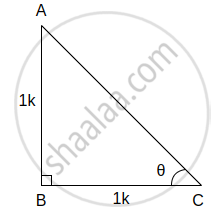
tan θ = `"Opposite side of θ"/"Adjacent side of θ"`
∴ tan θ = `"AB"/"BC"` ...(ii)
∴ `"AB"/"BC" = 1/1` ...[From (i) and (ii)]
Let the common multiple be k.
∴ AB = 1k and BC = 1k
Now, AC2 = AB2 + BC2 ...[Pythagoras theorem]
∴ AC2 = k2 + k2
∴ AC2 = 2k2
Taking square root of both sides,
∴ AC = `sqrt2k`
∴ sin θ = `"Opposite side of θ"/"Hypotenuse" = "AB"/"AC" = "1k"/(sqrt2"k") = 1/sqrt2`
∴ cos θ = `"Adjacent side of θ"/"Hypotenuse" = "BC"/"AC" = "1k"/(sqrt2"k") = 1/sqrt2`
(iv) sin θ = `1/2` ...(i)[Given]
In right angled ∆ABC, ∠C = θ
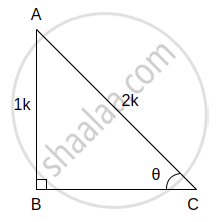
sin θ = `"Opposite side of θ"/"Hypotenuse"`
∴ sin θ = `"AB"/"AC"` ...(ii)
∴ `"AB"/"AC" = 1/2` ...[From (i) and (ii)]
Let the common multiple be k.
∴ AB = 1k and AC = 2k
Now, AC2 = AB2 + BC2 ...[Pythagoras theorem]
∴ (2k)2 = k2 + BC2
∴ 4k2 = k2 + BC2
∴ BC2 = 4k2 – k2
∴ BC2 = 3k2
Taking square root of both sides,
∴ BC = `sqrt3"k"`
∴ cos θ = `"Adjacent side of θ"/"Hypotenuse" = "BC"/"AC" = (sqrt3"k")/(2"k") = (sqrt3)/2`
tan θ = `"Opposite side of θ"/"Adjacent side of θ" = "AB"/"BC" = (1"k")/(sqrt3"k") = 1/sqrt3`
(v) cos θ = `1/sqrt3` ...(i)[Given]
In right angled ∆ABC, ∠C = θ
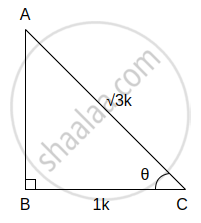
∴ cos θ = `"Adjacent side of θ"/"Hypotenuse"`
∴ cos θ = `"BC"/"AC"` ...(ii)
∴ `"BC"/"AC" = 1/sqrt3` ...[From (i) and (ii)]
Let the common multiple be k.
∴ `"AB" = 1"k" and "BC" = sqrt3"k"`
Now, AC2 = AB2 + BC2 ...[Pythagoras theorem]
`∴ (sqrt3"k")^2 = "AB"^2 + "k"^2`
∴ 3k2 = AB2 – k2
∴ AB2 = 3k2 – k2
∴ AB2 = 2k2
Taking square root of both sides,
AB = `sqrt2`k
∴ sin θ = `"Opposite side of θ"/"Hypotenuse" = "AB"/"AC" = (sqrt2"k")/(sqrt3"k") = sqrt2/sqrt3`
tan θ = `"Opposite side of θ"/"Adjacent side of θ" = "AB"/"BC" = (sqrt2"k")/(1"k") = sqrt2`
(vi) tan θ = `21/20` ...(i)[Given]
In right angled ∆ABC, ∠C = θ
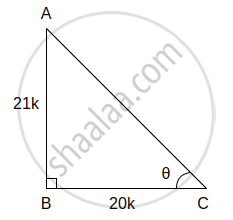
tan θ = `"Opposite side of θ"/"Adjacent side of θ"`
∴ tan θ = `"AB"/"BC"` ...(ii)
∴ `"AB"/"BC" = 21/20` ...[From (i) and (ii)]
Let the common multiple be k.
∴ AB = 21k and BC = 20k
Now, AC2 = AB2 + BC2 ...[Pythagoras theorem]
AC2 = (21k)2 + (20k)2
AC2 = 441k2 + 400k2
AC2 = (841k)2
Taking square root of both sides,
AC = 29k
∴ sin θ = `"Opposite side of θ"/"Hypotenuse" = "AB"/"AC" = (21"k")/(29"k") = 21/29`
cos θ = `"Adjacent side of θ"/"Hypotenuse" = "BC"/"AC" = (20"k")/(29"k") = 20/29`
(vii) tan θ = `8/15` ...(i)[Given]
In right angled ∆ABC, ∠C = θ.
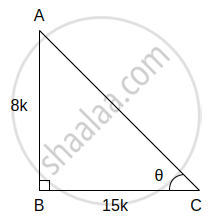
tan θ = `"Opposite side of θ"/"Adjacent side of θ"`
∴ tan θ = `"AB"/"BC"` ...(ii)
∴ `"AB"/"BC" = 8/15` ...[From (i) and (ii)]
Let the common multiple be k.
∴ AB = 8k and BC = 15k
Now, AC2 = AB2 + BC2 ...[Pythagoras theorem]
∴ AC2 = (8k)2 + (15k)2
∴ AC2 = 64k2 + 225k2
∴ AC2 = (289k)2
Taking square root of both sides,
∴ AC = 17k
∴ sin θ = `"Opposite side of θ"/"Hypotenuse" = "AB"/"AC" = (8"k")/(17"k") = 8/17`
cos θ = `"Adjacent side of θ"/"Hypotenuse" = "BC"/"AC" = (15"k")/(17"k") = 15/17`
(viii) sin θ = `3/5` ...(i)[Given]
In right angled ΔABC, ∠C = θ
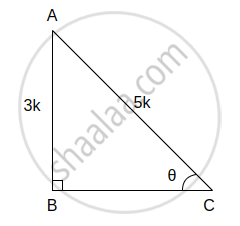
sin θ = `"Opposite side of θ"/"Hypotenuse"`
∴ sin θ = `"AB"/"AC"` ...(ii)
∴ `"AB"/"AC" = 3/5` ...[From (i) and (ii)]
Let the common multiple be k.
∴ AB = 3k and AC = 5k
Now, AC2 = AB2 + BC2 ...[Pythagoras theorem]
∴ (5k)2 = (3k)2 + BC2
∴ 25k2 = 9k2 + BC2
∴ BC2 = 25k2 – 9k2
∴ BC2 = 16k2
Taking square root of both sides,
∴ BC = 4k
∴ cos θ = `"Adjacent side of θ"/"Hypotenuse" = "BC"/"AC" = (4"k")/(5"k") = 4/5`
tan θ = `"Opposite side of θ"/"Adjacent side of θ" = "AB"/"BC" = (3"k")/(4"k") = 3/4`
(ix) tan θ = `1/(2sqrt2)` ...(i)[Given]
In right angled ∆ABC, ∠C = θ
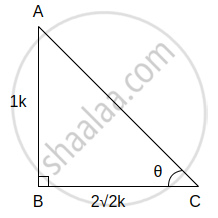
tan θ = `"Opposite side of θ"/"Adjacent side of θ"`
∴ tan θ = `"AB"/"BC"` ...(ii)
∴ `"AB"/"BC" = 1/(2sqrt2)` ...[From (i) and (ii)]
Let the common multiple be k.
∴ AB = 1k and BC = `2sqrt2"k"`
Now, AC2 = AB2 + BC2 ...[Pythagoras theorem]
∴ `"AC"^2 = (1"k")^2 + (2sqrt2"k")^2 `
∴ AC2 = 1k2 + 8k2
∴ AC2 = (9k)2
Taking square root of both sides,
∴ AC = 3k
∴ sin θ = `"Opposite side of θ"/"Hypotenuse" = "AB"/"AC" = (1"k")/(3"k") = 1/3`
cos θ = `"Adjacent side of θ"/"Hypotenuse" = "BC"/"AC" = (2sqrt2"k")/(3"k") = (2sqrt2)/3`
APPEARS IN
RELATED QUESTIONS
Find the value of the following:
sin 49°
Find the value of the following:
tan 54° 26′
Find the value of the following:
cos 33° 53′
Find the value of θ if sin θ = 0.9975
Find the value of θ if cos θ = 0.6763
Find the value of θ if tan θ = 0.0720
Find the value of θ if cos θ = 0.0410
Find the value of θ if tan θ = 7.5958
Find the value of the following:
tan 70° 58′ + cos 15° 26′ – sin 84° 59′
Find the value of the following:
tan 70° 17′
Find the area of a right triangle whose hypotenuse is 10 cm and one of the acute angle is 24°24′
In the given figure, HT shows the height of a tree standing vertically. From a point P, the angle of elevation of the top of the tree (that is ∠P) measures 42° and the distance to the tree is 60 metres. Find the height of the tree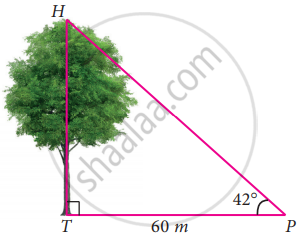
The value of 2tan45° – 2sin30° is ______.
