Advertisements
Advertisements
Question
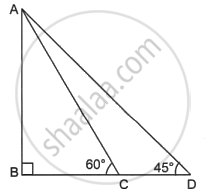
In the following figure, CD = 20 cm, find AB and BC.
Advertisements
Solution
Given:
CD = 20 cm.
AB ⟂ BD at B, so AB is vertical and BD is horizontal.
C and D lie on BD with C between B and D.
∠BCA = 60° and ∠CDA = 45° angles at C and D formed by the rays to A.
Step-wise calculation:
1. Put coordinates: B(0, 0).
Let BC = c, so C(c, 0) and D(c + 20, 0).
Let A be (0, h) so AB = h.
2. Angle at C: The angle between the leftward horizontal CB and CA equals 60°.
So, `tan 60^circ = h/c`
⇒ `sqrt(3) = h/c`
⇒ `h = csqrt(3)` ...(1)
3. Angle at D: The angle between the leftward horizontal DC and DA equals 45°.
So, `tan 45^circ = h/(c + 20)`
⇒ `1 = h/(c + 20)`
⇒ h = c + 20 ...(2)
4. Equate (1) and (2):
`csqrt(3) = c + 20`
`c(sqrt(3) - 1) = 20`
`c = 20/(sqrt(3) - 1)`
= `(20(sqrt(3) + 1))/(3 - 1)`
= `10(sqrt(3) + 1) . (BC)`
5. Then h = c + 20
= `10(sqrt(3) + 1) + 20`
= `10sqrt(3) + 30`
= `10(3 + sqrt(3)) . (AB)`
BC = `10(sqrt(3) + 1)` cm
= 27.3205 cm
AB = `10(3 + sqrt(3))` cm
= `30 + 10sqrt(3)` cm
= 47.3205 cm
CD = 20 cm, as given.
