Advertisements
Advertisements
Question
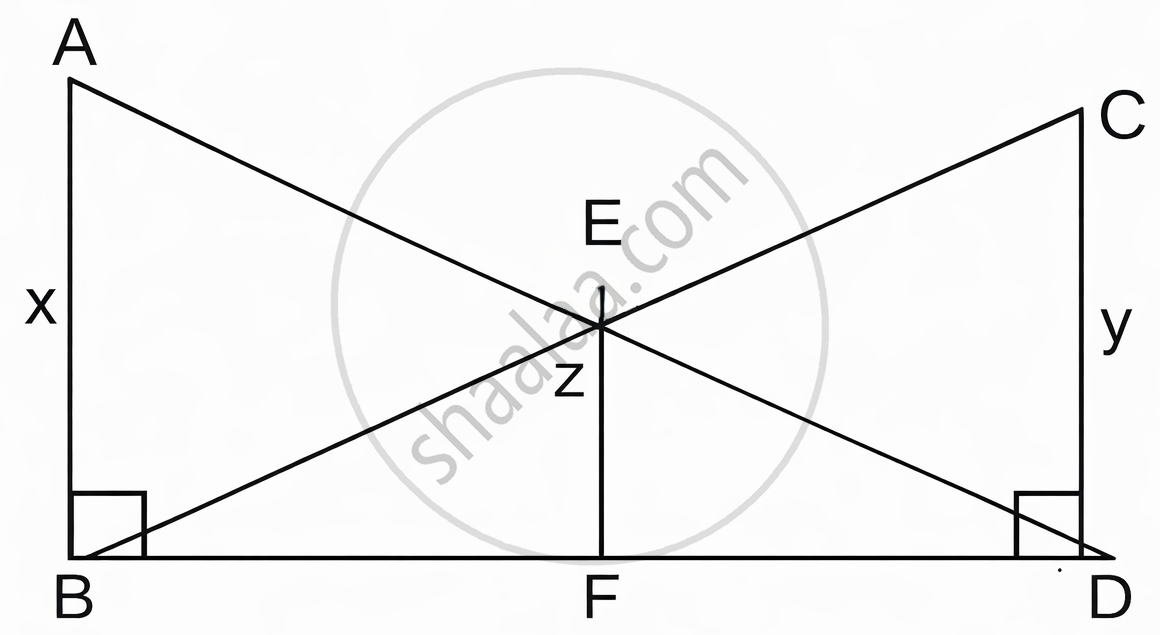
In the following figure, ∠ABD = ∠CDB = ∠EFD = 90°. If AB = x, CD = y, EF = z, prove that `1/z = 1/x + 1/y`:
Advertisements
Solution
Here,
AB = x, CD = y, EF = z, and ∠ABD = ∠CDB = ∠EFD = 90°
From the figure, AB and CD are perpendicular to BD, and lines AD and BC intersect at E. Also EF ⊥ BD.
⇒ In triangles ABE and DFE,
- ∠ABE = 90° and ∠DFE = 90°
- ∠AEB = ∠DEF (vertically opposite angles)
Therefore, △ABE ∼ △DFE, by AA similarity.
So, `(AB)/(DF) = (BE)/(FE) = (AE)/(DE)`
Hence, `(AB)/(EF) = (BE)/(DF) or x/z = (BE)/(DF)`
⇒ In triangles CDE and BFE,
- ∠CDE = 90° and ∠BFE = 90°
- ∠CED = ∠BEF (vertically opposite angles)
Therefore, △CDE ∼ △BFE by AA similarity.
So, `(CD)/(BF) = (DE)/(FE) = (CE)/(BE)`
Hence, `(CD)/(EF) = (DE)/(BF) or Y/z = (DE)/(BF)`
From the similarity of △ABE and △DFE,
`(BE)/(FE) = (DF)/(AB)`
`BE = (z xx DF)/y`
From the similarity of △CDE and △BFE,
`(DE)/(FE) = (BF)/(CD)`
`DE = (z xx BF)/y`
A simpler route is to use the corresponding proportional results as:
`(DF)/x = (BE)/x, (BF)/z = (DE)/y`
But, BF + FD = BD
Using the similar-triangle relations directly:
`z/x = (DF)/(BD) and z/y = (BF)/(BD)`
Adding,
`z/x + z/y = (DF)/(BD) + (BF)/(BD)`
`z/x + z/y = (DF + BF)/BD`
`z/x + z/y = (BD)/(BD)`
∴ `z/x + z/y = 1`
Divide by z:
`1/x + 1/y = 1/z`
Hence proved.
