Advertisements
Advertisements
Question
In the figure, PT is parallel to SR. QTSR is a parallelogram and PQSR is a rectangle. If the area of ΔQTS is 60cm2, find:
(i) the area o || gm QTSR
(ii) the area of the rectangle PQRS
(iii) the area of the triangle PQS.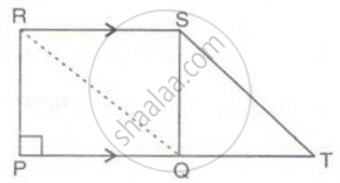
Advertisements
Solution
(i) ar(ΔQTS) = `(1)/(2)` x ar(parallelogram QTSR)
(The area of a triangle is half that of a parallelogram on the same base and between the same parallels)
⇒ ar(parallelogram QTSR) = 2 x ar(ΔQTS)
⇒ ar(parallelogram QTSR) = 2 x 60cm2
⇒ ar(parallelogram QTSR) = 120cm2
(ii) ar(ΔQTS) = `(1)/(2)` x ar(parallelogram QTSR)
ar(ΔQTS) = ar(ΔRSQ) = 60cm2
Now,
ar(ΔRSQ) = `(1)/(2)` x ar(rectangle PQRS)
⇒ ar(rectangle PQRS) = 2 x ar(ΔRSQ)
⇒ ar(rectangle PQRS) = 2 x 60cm2
⇒ ar(rectangle PQRS) = 120cm2
(iii) Since PQRS is a rectangle,
Therefore RS = PQ .....(i)
QTSR is a parallelogram,
Therefore, RS = QT .....(ii)
From (i) and (ii)
PQ = QT .......(iii)
In ΔPSQ and ΔQST
QS = QS
PQ = QT ...(from (iii))
∠PQS = ∠SQT = 90°
Therefore, ΔPSQ ≅ ΔQST
Area of two congruent triangles is equal.
Hence, ar(ΔPSQ) = ar(ΔQTS) = 60cm2.
