Advertisements
Advertisements
Question
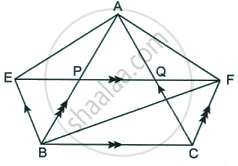
In the adjoining figure, PQ || BC, BE || CA and CF || BA. Prove that area of ΔABE = area of ΔACF.
Advertisements
Solution
Given: PQ || BC, BE || CA and CF || BA. Points E and F lie on a line EF, which contains P and Q, so EF contains segment PQ, hence EF || BC.
To Prove: Area (ΔABE) = Area (ΔACF).
Proof [Step-wise]:
1. Place a coordinate system to simplify computation (valid synthetic technique).
Put B = (0, 0), C = (1, 0) so BC is the x-axis.
Let A = (0, h) with h ≠ 0 (A above the base).
Because PQ ⊥? (given PQ || BC) the line EF that contains P and Q is parallel to BC.
So, EF is a horizontal line y = k for some k (0 < k < h in the picture).
2. AC has slope `(0 - h)/(1 - 0) = -h`.
Since BE || AC and passes through B(0, 0), the equation of BE is y = –hx.
Its intersection with EF (y = k) gives E:
k = –hxE
⇒ `x_E = -k/h`
So, `E = (-k/h, k)`.
3. AB is the vertical line x = 0.
Since CF || AB and passes through C(1, 0), CF is the vertical line x = 1.
Its intersection with EF (y = k) gives F = (1, k).
4. Compute area (ΔABE).
Using the determinant formula for area.
Area (ΔABE) = `1/2` |det(B – A, E – A)
B – A = (0, 0) – (0, h)
= (0, –h)
`E - A = (-k/h, k) - (0, h)`
= `(-k/h, k - h)`
`det = (0)(k - h) - (-h)(-k/h)`
= 0 – k
= –k
Hence, Area (ΔABE) = `1/2 |-k| = k/2`.
5. Compute area (ΔACF).
C – A = (1, 0) – (0, h)
= (1, –h)
F – A = (1, k) – (0, h)
= (1, k – h)
det = (1)(k – h) – (–h)(1)
= k – h + h
= k
Hence, Area (ΔACF) = `1/2 |k| = k/2`.
6. From steps 4 and 5, we get
`"Area" (ΔABE) = k/2 = "Area" (ΔACF)`
Area (ΔABE) = Area (ΔACF).
Hence proved.
