Advertisements
Advertisements
Question
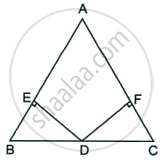
In the adjoining figure, D is the mid-point of BC. DE and DF are perpendiculars to AB and AC respectively, such that DE = DF. Prove that ΔABC is an isosceles triangle.
Theorem
Advertisements
Solution
Given: D is the midpoint of BC. DE ⟂ AB and DF ⟂ AC, with DE = DF.
To Prove: ΔABC is isosceles (i.e. AB = AC).
Proof [Step-wise]:
- Points E and F are the feet of perpendiculars from D on AB and AC, so ∠AED = ∠AFD = 90°. (Given construction)
- Consider right triangles ΔADE and ΔADF. AD is common to both triangles and DE = DF is given.
- In the two right triangles, the two corresponding legs AD and DE equal AD and DF respectively, so ΔADE ≅ ΔADF (congruence of right triangles by leg–leg / RHS criteria).
- From the congruence we get ∠DAE = ∠DAF; hence AD bisects ∠A. (CPCTC)
- By the Angle Bisector Theorem, an internal bisector from A meets BC at D with `(BD)/(DC) = (AB)/(AC)`.
- But D is the midpoint of BC, so BD = DC, therefore `(BD)/(DC) = 1`, so `(AB)/(AC) = 1` and thus AB = AC.
AB = AC, so ΔABC is isosceles.
shaalaa.com
Is there an error in this question or solution?
