Advertisements
Advertisements
Question
In the adjoining figure, AP = 1 cm, BP = 2 cm, AQ = 1.5 cm, and AC = 4.5 cm.
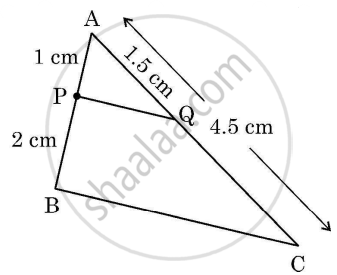
Prove that ΔАPQ ~ ΔАВС. Hence, find the length of PQ if BC = 3.6 cm.
Theorem
Advertisements
Solution
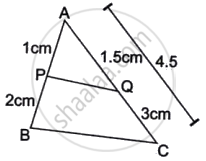
Given, AP = 1 cm, BP = 2 cm, AQ = 1.5 cm, AC = 4.5 cm
QC = AC – AQ
= 3 cm
In ΔAPQ and ΔABС
`(AP)/(AB) = 1/3, (AQ)/(AC) = 1.5/7.5 = 1/3`
∠PAQ = ∠BAC ....(Common)
ΔАРО ∼ ΔАВС ....(By S.A.S. similarity rule)
`(AP)/(AB) = (PQ)/(BC)` ....(By Thale’s theorem)
`1/(AP + PB) = (PQ)/3.6` ....(AP = 1 cm and BC = 3.6 cm)
`1/(1 + 2) = (PQ)/3.6`
PQ = 1.2 cm
shaalaa.com
Is there an error in this question or solution?
