Advertisements
Advertisements
Question
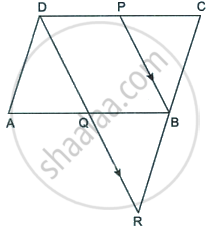
In the adjoining figure, ◻ABCD is a parallelogram. P is the mid-point of CD and DQ || PB meets CB produced at R.
Prove that:
- AD = `1/2` CR
- DR = 2 PB
Advertisements
Solution
Given: ABCD is a parallelogram.
P is the midpoint of CD.
DQ || PB and the line DQ meets the extension of CB at R.
To Prove:
- AD = `1/2` CR
- DR = 2 PB
Proof [Step-wise]:
1. Set a coordinate system valid because the figure is affine:
Let A = (0, 0), B = (b, 0) with b ≠ 0, and D = (0, d) with d ≠ 0.
Then C = B + D – A = (b, d).
2. P is the midpoint of CD.
So, `P = ((c_x + d_x)/2, (c_y + d_y)/2)`
= `((b + 0)/2, d)`
= `(b/2, d)`
3. Vector PB = B – P
= `((b - b)/2, 0 - d)`
= `(b/2, -d)`
Since DQ || PB, the line through D meeting CB produced i.e. the line x = b has parametric form
`R(t) = D + t xx (b/2, -d)`
= `(0 + t xx b/2, d − t xx d)`
The x-coordinate of R must be b.
So, `t xx (b/2) = b`
⇒ t = 2
Hence, `R = D + 2 xx (b/2, -d)`
= (b, d – 2d)
= (b, –d)
4. Compute CR and AD:
C = (b, d),
R = (b, –d)
⇒ CR is vertical of length |d – (–d)| = 2d.
AD is vertical from A(0, 0) to D(0, d) of length d.
Therefore, AD = d
= `(1/2) xx (2d)`
= `(1/2) xx CR`
This proves (i).
5. Compute lengths DR and PB:
PB vector = `(b/2, -d)`
⇒ `|PB|^2 = (b/2)^2 + d^2`
= `b^2/4 + d^2`
DR vector = R − D
= (b, –2d)
⇒ |DR|2 = b2 + (2d)2
= b2 + 4d2
Observe `|DR|^2 = 4 xx (b^2/4 + d^2)`
= 4 × |PB|2
So, |DR| = 2 × |PB|.
Hence, DR = 2 PB.
This proves (ii).
Using coordinates equivalently by affine geometry / midpoint-parallel reasoning, we obtain AD = `1/2` CR and DR = 2 PB, as required.
