Advertisements
Advertisements
Question
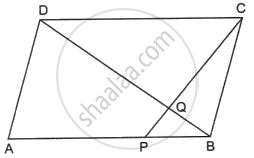
In the adjoining figure; ABCD is a parallelogram. If AP = BP and CP meets the diagonal BD at Q and area of ΔBPQ = 20 cm2, find:
- PQ : QC.
- Area of ΔPBC.
- Area of parallelogram ABCD.
Advertisements
Solution
Given: ABCD is a parallelogram. P lies on AB with AP = BP, so P is the midpoint of AB. CP meets diagonal BD at Q. Area (ΔBPQ) = 20 cm2.
Step-wise calculation:
1. Put coordinates (convenient choice):
A = (0, 0), B = (2, 0)
So, P = (1, 0).
Let D = (u, v)
So, C = B + AD = (2 + u, v).
Parametrize BD:
B + s(D – B) = (2 + s(u – 2), sv).
Parametrize CP:
C + t(P – C) = (2 + u – t(1 + u), v(1 – t)).
Equate y-coordinates:
sv = v(1 – t)
⇒ s = 1 – t
Equate x-coordinates and substitute s = 1 – t.
Solve for t:
t(2 – u) = 2 – t(1 + u)
⇒ 3t = 2
⇒ `t = 2/3`
So, `s = 1/3`.
Thus, Q divides CP with CQ : QP
= t : (1 – t)
= `2/3 : 1/3`
= 2 : 1
So, PQ : QC = 1 : 2.
2. Areas on the same altitude:
ΔBPQ and ΔBPC share the same altitude from B to line PC.
So, `("Area"(ΔBPQ))/("Area"(ΔBPC))`
= `(PQ)/(PC)`
= `1/3`
Therefore, Area (ΔBPC)
= 3 × Area (ΔBPQ)
= 3 × 20
= 60 cm2
3. Relation to parallelogram area:
With P the midpoint of AB, vector argument or coordinate calc gives Area (ΔBPC) = `1/4` × Area (parallelogram ABCD).
Hence, Area (ABCD)
= 4 × Area (ΔBPC)
= 4 × 60
= 240 cm2
