Advertisements
Advertisements
Question
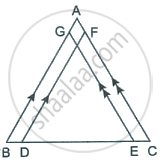
In the adjoining figure, AB || FD, AC || GE and BD = EC. Prove that:
- BG = DF
- EG = CF.
Advertisements
Solution
Given:
AB || FD, AC || GE and BD = EC in triangle ABC with D and E on BC, F on AC and G on AB as in the figure.
To Prove:
- BG = DF
- EG = CF
Proof [Step-wise]:
1. Place coordinates: Let B = (0, 0), C = (c, 0) (c > 0).
Let A = (0, a) with a > 0.
This choice makes AB vertical; the argument below is purely affine and equivalent to a synthetic proof using parallel-lines properties.
2. Put E = (e, 0) point on BC.
Since BD = EC and B is at 0.
D is at x = d where BD = d and EC = c – e.
BD = EC
⇒ d = c – e
So, D = (d, 0) = (c – e, 0).
3. Find G intersection of the line through E parallel to AC with AB:
Slope of AC
= `(0 - a)/(c - 0)`
= `-a/c`
A line through E = (e, 0) with that slope has equation `y = (-a/c)(x - e)`.
Its intersection with AB (x = 0) gives G = `(0, a e/c)`.
Hence BG = distance from B(0, 0) to `G(0, a e/c) = a e/c`.
Using the standard alternate-angle / parallel-line facts to get the same proportional relation is allowed; see parallel-line theorems.
4. Find F intersection of the line through D parallel to AB with AC.
Because AB is vertical, the line through D parallel to AB is vertical x = d.
Its intersection with AC line from A(0, a) to C(c, 0) with equation `y = a(1 - x/c)` is `F = (d, a(1 - d/c))`.
So DF = vertical distance = `a(1 - d/c)`.
5. Use d = c – e to compare BG and DF:
`BG = a e/c`,
`DF = a(1 - d/c)`
= `a(1 - (c - e)/c)`
= `a(e/c)`
Therefore, BG = DF.
This proves (i).
6. Compute EG and CF to prove (ii).
EG = distance between E(e, 0) and `G(0, a e/c)`:
`EG = sqrt(e^2 + (a e/c)^2)`
= `e xx sqrt(1 + (a^2/c^2))`
CF = distance between C(c, 0) and `F(d, a(1 - d/c))`.
Note c – d
= c – (c – e)
= e
And `1 - d/c = e/c`
So, the vector CF
= `(d - c, a(1 - d/c))`
= `(-e, a e/c)`
Hence, `CF = sqrt(e^2 + (a e/c)^2)`
= `e xx sqrt(1 + (a^2/c^2))`
Thus, EG = CF.
This proves (ii).
(i) BG = DF and (ii) EG = CF, as required.
