Advertisements
Advertisements
Question
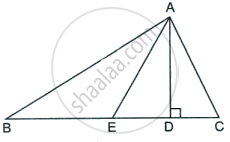
In the adjoining figure, AB > AC, BE = EC and ∠ADC = 90°.
Prove that:
- AB2 – AC2 = 2BC.ED
- AB2 + AC2 = 2(AE2 + BE2)
Advertisements
Solution
Given: In the adjoining figure AB > AC, BE = EC and ∠ADC = 90°.
To Prove:
- AB2 – AC2 = 2BC.ED
- AB2 + AC2 = 2(AE2 + BE2)
Proof [Step-wise]:
1. Coordinate the setup of a convenient frame.
Put BC on the x-axis and choose E as the origin.
Let BE = EC = a
So, B = (–a, 0)
E = (0, 0)
C = (a, 0)
Hence, BC = 2a.
Let D = (d, 0) for some d with –a < d < a.
Since ∠ADC = 90°, A lies on the line through D perpendicular to BC.
So, write A = (d, h) with h ≠ 0 take h > 0.
The given AB > AC implies AB2 – AC2 > 0 and as computed below forces d > 0; we keep d as the signed x-coordinate of D.
2. Express squared distances.
AB2 = (xA – xB)2 + (yA – yB)2
= (d – (–a))2 + h2
= (d + a)2 + h2
AC2 = (d – a)2 + h2
AE2 = (d – 0)2 + h2
= d2 + h2
BE2 = (–a – 0)2 + 02
= a2
ED = Distance from E(0, 0) to D(d, 0) = |d|.
With AB > AC we will have d > 0.
So, ED = d.
3. Prove (i): AB2 – AC2 = 2 × BC × ED.
Compute the difference:
AB2 − AC2
= [(d + a)2 + h2] – [(d – a)2 + h2]
= (d + a)2 – (d – a)2
Expand or use difference of squares:
(d + a)2 – (d – a)2
= [d2 + 2ad + a2] – [d2 – 2ad + a2]
= 4ad
Since BC = 2a and ED = d because AB > AC gives d > 0.
2 × BC × ED
= 2 × (2a) × d
= 4ad
Hence, AB2 – AC2 = 4ad = 2 × BC × ED, as required.
4. Prove (ii): AB2 + AC2 = 2(AE2 + BE2).
Sum the squares:
AB2 + AC2
= [(d + a)2 + h2] + [(d – a)2 + h2]
= (d + a)2 + (d – a)2 + 2h2
Compute (d + a)2 + (d – a)2 = 2(d2 + a2).
So, AB2 + AC2
= 2(d2 + a2) + 2h2
= 2(d2 + h2 + a2)
But AE2 + BE2 = (d2 + h2) + a2.
So, 2(AE2 + BE2) = 2(d2 + h2 + a2).
Therefore, AB2 + AC2 = 2(AE2 + BE2), as required.
