Advertisements
Advertisements
Question
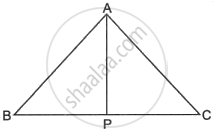
In the adjoining figure, AB = AC and AP is the bisector of ∠A. Prove that:
- P is the mid-point of BC
- AP is perpendicular to BC
Theorem
Advertisements
Solution
Given:
- In triangle ABC, AB = AC (so triangle ABC is isosceles with apex A).
- P lies on BC and AP bisects ∠A (i.e. ∠BAP = ∠PAC).
To Prove:
- P is the midpoint of BC (i.e. BP = PC).
- AP is perpendicular to BC (i.e. AP ⟂ BC).
Proof [Step-wise]:
1. Consider triangles ΔABP and ΔAPC.
2. AB = AC. ...(Given)
3. AP = AP. ...(Common side)
4. ∠BAP = ∠PAC. ...(AP is the bisector of ∠A)
5. From (2), (3) and (4),
ΔABP ≅ ΔPAC by SAS congruence of two sides and the included angle.
6. From congruence, corresponding sides BP and PC are equal.
Hence, BP = PC, so P is the midpoint of BC.
This proves (i).
7. Also from congruence, corresponding angles ∠APB and ∠CPA are equal.
8. Since B, P, C are collinear, ∠APB and ∠APC are a linear pair and therefore ∠APB + ∠APC = 180°.
9. With ∠APB = ∠APC (step 7), each must be 90°.
Thus ∠APB = 90°, so AP ⟂ BC.
This proves (ii).
shaalaa.com
Is there an error in this question or solution?
