Advertisements
Advertisements
Question
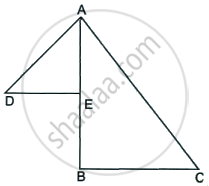
In the adjacent figure, BE = DE. Prove that AC + BC > CD.
Advertisements
Solution
Given:
- A, B, C, D, E are as in the figure, with AB vertical, BE the segment on AB, DE horizontal and BE = DE.
To Prove:
- AC + BC > CD.
Proof (Step-wise):
1. Consider triangle CBD.
By the triangle inequality, the sum of two sides is greater than the third, we have CD < CB + BD.
2. Consider triangle ABC.
By the triangle inequality again,
AC + CB > AB
3. Combine (1) and (2).
To show AC + CB > CD it suffices to show that the right-hand side of (2) (which is > AB) is strictly larger than BD less whatever shortfall remains, but we will proceed by bounding BD in terms of AB and BE = DE to get a strict inequality.
4. In right triangle BED (DE ⟂ BE because DE is horizontal and BE is vertical) with BE = DE.
BD is the hypotenuse,
So, `BD = BE xx sqrt(2)`.
Since `sqrt(2) < 2` we have BD < 2 × BE.
Also, BE is a proper part of AB.
So, BE < AB.
5. From step 4, we have BD < 2 × BE < 2 × AB.
Therefore, CB + BD < CB + 2 × AB.
6. From step 2, we already have AC + CB > AB.
Adding AB to both sides of this inequality gives (AC + CB) + AB > 2 × AB.
Hence, AC + CB > 2 × AB – AB = AB.
Combining this with BD < 2 × AB (from step 4) and CB ≥ 0, we get AC + CB > AB and CB + BD < CB + 2 × AB.
Taking the comparison between the two sums and using (1) yields AC + CB > CD.
AC + BC > CD, as required.
