Advertisements
Advertisements
Question
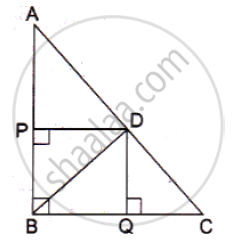
In a right triangle ABC, right angled at B, D is a point on hypotenuse such that BD ⊥ AC , if DP ⊥ AB and DQ ⊥ BC then prove that
`(a) DQ^2 Dp.QC (b) DP ^2 DQ.AP 2 `
Advertisements
Solution
We know that if a perpendicular is drawn from the vertex of the right angle of a right triangle to the hypotenuse then the triangles on the both sides of the perpendicular are similar to the whole triangle and also to each other.
(a) Now using the same property in In ΔBDC, we get
ΔCQD ~ ΔDQB
`(CQ)/(DQ)=(DQ)/(QB)`
⟹`DQ^2=QB.CQ`
Now. Since all the angles in quadrilateral BQDP are right angles.
Hence, BQDP is a rectangle.
So, QB = DP and DQ = PB
∴ `DQ^2=DP.CQ`
(b) Similarly, ΔAPD ~ ΔDPB
`(AP)/(DP)=(PD)/(PB)`
⟹ `DP^2=AP.PB`
⟹`DP^2=AP.DQ` [∵ 𝐷𝑄 = 𝑃𝐵]
shaalaa.com
Is there an error in this question or solution?
