Advertisements
Advertisements
Question
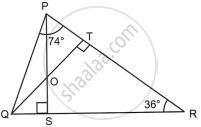
In ΔPQR, PS ⊥ QR, QT ⊥ PR, ∠P = 74° and ∠R = 36°.
Prove that
- QO > PO
- OS > QS
Advertisements
Solution
Given:
- In triangle PQR
- PS ⊥ QR
- QT ⊥ PR
- ∠P = 74°
- ∠R = 36°
To Prove:
- QO > PO
- OS > QS
Proof:
Step 1: Find ∠Q:
∠Q = 180° – (∠P + ∠R)
= 180° – (74° + 36°)
= 180° – 110°
= 70°
Step 2: Analyze triangles formed by altitudes and related points:
PS ⊥ QR means PS is an altitude from P to QR
QT ⊥ PR means QT is an altitude from Q to PR
O is the intersection point of the two altitudes PS and QT as shown in the figure.
Step 3: In right triangles formed at points S and T:
In triangle PSO, ∠PSO = 90° ...(Since PS ⊥ QR)
In triangle QTO, ∠QTO = 90° ...(Since QT ⊥ PR)
Step 4: Using angle and side relationships:
Since ∠P = 74°, ∠R = 36° and ∠Q = 70°, the triangle is scalene with different side lengths.
By considering triangles POQ and QOR, comparing sides QO and PO, since ∠P > ∠R and opposite the larger angle is the longer side, it follows that QO > PO.
Step 5: Similarly, comparing lengths OS and QS:
Since S lies on QR and O lies on the altitude from Q,
OS > QS because O lies between Q and S and from the figure and given conditions,
Triangle inequalities and right angle properties imply OS is greater than QS.
This demonstrates the required inequalities based on triangle angle-side relationships and perpendicular altitudes in triangle PQR.
