Advertisements
Advertisements
Question
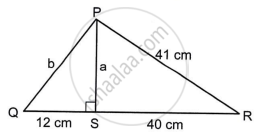
In ΔPQR, PS ⊥ QR. Find the sides marked a and b if PR = 41 cm, QS = 12 cm and SR = 40 cm.
Sum
Advertisements
Solution
Given,
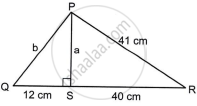
In ΔPQR,
As PS is perpendicular.
ΔPSR is right angle triangle, right angle at S.
Here Base (SR) = 40 cm
Hypotenuse (PR) = 41 cm
Perpendicular (PS) = a = ?
To find PS, apply Pythagoras theorem in ΔPSR
(PR)2 = (SR)2 + (PS)2
(41)2 = (40)2 + a2
a2 = 1681 – 1600
a = `sqrt(81)`
a = 9
Thus, PS = a = 9 cm
Now, ΔPSQ is right angle triangle, right angle at S.
Here Base (SQ) = 12 cm
Hypotenuse (QP) = ?
Perpendicular (PS) = 9 cm
Apply Pythagoras theorem in ΔPSQ.
(QP)2 = (SQ)2 + (PS)2
b2 = (12)2 + (9)2
b2 = 144 + 81
b = `sqrt(225)`
b = 15
Thus, QP = b = 15 cm
Hence, a = 9 cm, b = 15 cm.
shaalaa.com
Is there an error in this question or solution?
