Advertisements
Advertisements
Question
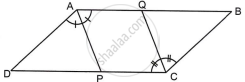
In parallelogram ABCD, PA and QC are bisectors of ∠A and ∠C respectively. Prove that APCQ is a parallelogram.
Advertisements
Solution
Consider the figure given below.
We know that opposite angles of a parallelogram are equal.
So ∠A = ∠C and ∠B = ∠D.
⇒ ∠A = ∠C
⇒ `1/2 ∠A = 1/2 ∠C`
⇒ ∠DAP = ∠BCQ
For ΔADP and ΔCBQ,
∠D = ∠B ...[Properrty of parallelegram]
AD = CB ...[Opposite sides of parallelegram]
∠DAP = ∠BCQ ...[Proved above]
Therefore, by congruency criterion, ΔADP ≅ ΔCBQ.
Now by corresponding parts of congruent triangles (CPCT), ∠DPA = ∠CQB.
⇒ 180 – ∠CPA = 180 – ∠CQA (since DPA and ∠CPA form a linear pair and ∠CQB and ∠CQA form another linear pair)
⇒ ∠CPA = ∠CQA ...(1)
Also as `1/2 ∠A = 1/2 ∠C`, we get ∠PAQ = ∠PCQ ...(2)
From equations (1) and (2), we can say that opposite angles of quadrilateral AQCP are equal.
Therefore APCQ is a parallelogram.
Hence, the given statement is proved.
