Advertisements
Advertisements
Question
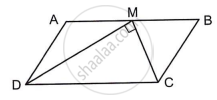
In || gm ABCD, M is a point on AB, ∠DMC = 90°. DM = 15 cm, DC = 17 cm. ∴ Area of || gm ABCD is:
Options
60 cm2
68 cm2
120 cm2
136 cm2
Advertisements
Solution
120 cm2
Explanation:
You have a right-angled triangle ΔDMC inside the parallelogram.
We know two sides: DM = 15 cm and DC (hypotenuse) = 17 cm.
Using the Pythagorean theorem (a2 + b2 = c2), we can find the third side, MC.
152 + MC2 = 172
225 + MC2 = 289
MC2 = 289 − 225 = 64
MC = `sqrt64` = 8 cm
Calculate the area of the triangle ΔDMC:
Since ΔDMC is a right-angled triangle, its area is `1/2` × base × height.
Using DM as height and MC as base: Area = `1/2 xx 8 xx 15 = 60` cm2
Relate the triangle’s area to the parallelogram’s area to find the height (h):
The area of a parallelogram is given by: Area = base × height.
In ΔDMC, if we consider DC (17 cm) as the base, then the height corresponding to this base is the perpendicular distance from M to DC. This perpendicular distance is also the height (h) of the parallelogram (because M is on AB, and AB is parallel to DC).
So, we can also write the area of ΔDMC as `1/2 xx DC xx h`
We know Area of ΔDMC = 60 cm2 and DC = 17 cm
`60 xx 1/2 xx 17 xx h`
120 = 17 × h
h = `120/17` cm
Calculate the area of the parallelogram:
Now we have the base of the parallelogram (DC = 17 cm) and its height (h = `120/17` cm)
Area of parallelogram ABCD = base × height = `17 xx 120/17`
Area of parallelogram ABCD = 120 cm2
