Advertisements
Advertisements
Question
In the following figure, what is the ratio of the areas of
- shaded portion I to shaded portion II?
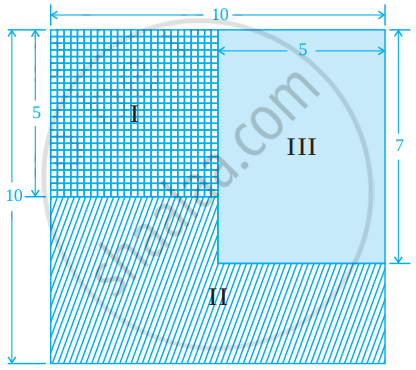
- shaded portion II to shaded portion III?
- shaded portions I and II taken together and shaded portion III?
Advertisements
Solution
Area of square = Side × Side
Area of rectangle = Length × Breadth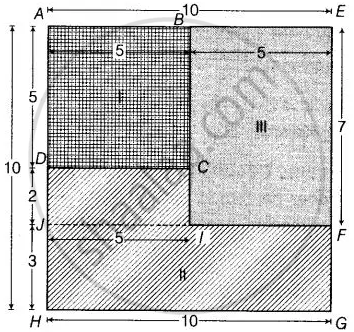
From the above figure, we can say that
AB = AE – BE = 10 – 5 = 5
BI = EF = AJ = AD + DJ = 5 + 2 = 7
FG = HJ = 3
FI = BE = 5
DC = IJ = AB = 5
DC = IJ = AB = 5
CI = DJ = 2
BC = AD = 5
Now, area of I portion = Area of ABCD
= AB × BC
= 5 × 5
= 25 sq units
Area of III portion = Area of BEFI
= BF × EF
= 5 × 7
= 35 sq units
Area of II portion = Area of DCIJ + Area of FGHI
= DC × CI + GH × HJ
= 5 × 2 + 10 × 3
= 10 + 30
= 40 sq units
a. Ratio of shaded portion I to shaded portion II
= `25/40`
= `5/8`
= 5 : 8
b. Ratio of shaded portion II to shaded portion III
= `40/35`
= `8/7`
= 8 : 7
c. Ratio of shaded portion I and II taken together to shaded portion III
= `(25 + 40)/35`
= `65/35`
= `13/7`
= 13 : 7
