Advertisements
Advertisements
Question
In ΔABC, AP ⊥ BC and BQ ⊥ AC, B−P−C, A−Q−C, then show that ΔCPA ~ ΔCQB. If AP = 7, BQ = 8, BC = 12, then AC = ?
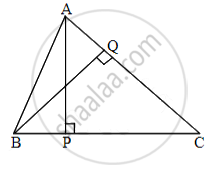
In ΔCPA and ΔCQB
∠CPA ≅ [∠ ______] ...[each 90°]
∠ACP ≅ [∠ ______] ...[common angle]
ΔCPA ~ ΔCQB ......[______ similarity test]
`"AP"/"BQ" = (["______"])/"BC"` .......[corresponding sides of similar triangles]
`7/8 = (["______"])/12`
AC × [______] = 7 × 12
AC = 10.5
Fill in the Blanks
Sum
Advertisements
Solution
In ΔCPA and ΔCQB
∠CPA ≅ ∠CQB ...[each 90°]
∠ACP ≅ ∠BCQ ...[common angle]
ΔCPA ~ ΔCQB ...[AA similarity test]
`"AP"/"BQ"` = `"AC"/"BC"` ...[corresponding sides of similar triangles]
`7/8` = `"AC"/12`
AC × 8 = 7 × 12
AC = `(7 xx 12)/8`
AC = `(7 xx 3)/2`
AC = `21/2`
AC = 10.5.
shaalaa.com
Is there an error in this question or solution?
