Advertisements
Advertisements
Question
In ΔABC, PQ || BC. Prove that
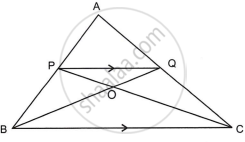
- Area (ΔPBC) = Area (ΔQBC)
- Area (ΔPOB) = Area (ΔQOC)
Theorem
Advertisements
Solution
Given: PQ || BC
Step 1: Use the property of parallel lines in triangles
If a line is drawn parallel to the base of a triangle, then it divides the other two sides proportionally:
`(AP)/(AB) = (AQ)/(AC)`
i. Prove that Area(ΔPBC) = Area(ΔQBC)
- Let h be the perpendicular distance from B to PQ and h’ be the perpendicular distance from C to PQ
- Triangles ΔPBC and ΔQBC share the same base BC.
The area of a triangle:
Area = `1/2` × base × height
- For ΔPBC, height = perpendicular from P to BC (or along the line joining P parallel to BC) and similarly for ΔQBC.
- Since PQ || BC, the perpendicular distances from P and Q to BC are the same.
Area(ΔPBC) = `1/2` × BC × height = Area(ΔQBC)
Hence, Area(ΔPBC) = Area(ΔQBC).
ii. Prove that Area(ΔPOB) = Area(ΔQOC)
Assume O is the point of intersection of the medians or some reference point inside the triangle (typically the centroid or origin).
- Triangles ΔPOB and ΔQOC share the same height from line PQ to O because PQ || BC.
- Also, the bases PB and QC are equal due to the proportional division by the parallel line:
`(AP)/(AB) = (AQ)/(AC)`
⇒ PB = QC - Using the area formula for a triangle:
Area = `1/2` × base × height
Area(ΔPOB) = Area(ΔQOC)
Hence, Area(ΔPOB) = Area(ΔQOC).
shaalaa.com
Is there an error in this question or solution?
