Advertisements
Advertisements
Question
In ΔABC, D is the midpoint of BC and AE⊥BC. If AC>AB, show that `AB^2= AD^2+1/4 BC^2 −BC.DE `
Advertisements
Solution
In right-angled triangle AED, applying Pythagoras theorem, we have:
`AB^2=AE^2+ED^2` ...........(1)
In right-angled triangle AED, applying Pythagoras theorem, we have:
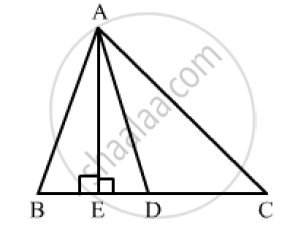
`AD^2=AE^2+ED^2`
`⇒ AE^2=AD^2-ED^2` ...............(2)
Therefore,
`AB^2=AD^2-ED^2+EB^2` (from(1) and (2))
`AB^2=AD^2-ED^2+(BD-DE)^2`
`=AD^2-ED^2+(1/2BC-DE)^2`
`=AD^2-DE^2+1/4BC^2+DE^2-BC.DE`
`=AD^2+1/4BC^2-BC.DE`
This completes the proof.
shaalaa.com
Is there an error in this question or solution?
