Advertisements
Advertisements
Question
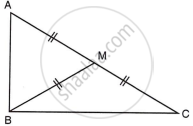
In ΔABC, AM = MC = BM. Prove that ∠ABC = 90°.
Advertisements
Solution
Given:
- ΔABC such that AM = MC = BM,
- We need to prove that ∠ABC = 90°.
Proof:
We are given that:
- AM = MC (i.e., M is the midpoint of AC),
- BM = AM (i.e., BM = MC).
This suggests a few important geometric properties that we can use to prove that ∠ABC = 90°.
Step 1: Analyze the triangle
Since M is the midpoint of AC, we have AM = MC
Also, BM = AM, which means that triangle ABM is isosceles, with AB = BM and AM = MC.
Therefore, triangle ABM is isosceles with equal sides AB = BM.
Step 2: Recognize the type of triangle
Because M is the midpoint of side AC and BM = AM, the triangle ABM must be an isosceles triangle. In addition, if BM = AM, we have symmetry and the angle ∠BAM must be equal to ∠ABM.
Step 3: Apply the property of the isosceles triangle
In an isosceles triangle, the base angles are equal.
So ∠BAM = ∠ABM
Since the sum of angles in a triangle is 180°, we can write the equation for the angles in triangle ABM:
∠BAM + ∠ABM + ∠AMB = 180°
Since ∠BAM = ∠ABM, we have 2 × ∠BAM + ∠ABM = 180°
Thus, the angle ∠AMB is ∠AMB = 180° – 2 × ∠BAM.
Step 4: Use the perpendicular bisector property
Given that M is the midpoint of AC, the line BM is a perpendicular bisector of AC.
Therefore, ∠AMB = 90°
Thus, we have 90° = 180° – 2 × ∠BAM
Solving for ∠BAM:
2 × ∠BAM = 90°
⇒ ∠BAM = 45°
Step 5: Conclude that ∠ABC = 90°
Since ∠BAM = 45° and ∠ABM = 45°, the total angle ∠ABC is ∠ABC = 45° + 45° = 90°.
