Advertisements
Advertisements
Question
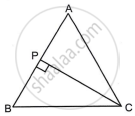
In ΔABC, AB = AC and CP ⊥ AB. Prove that
- 2AB . BP = BC2
- CP2 – BP2 = 2AP . BP
Advertisements
Solution
Given:
In triangle ΔABC,
AB = AC ...(i.e., ΔABC is isosceles with AB = AC)
CP ⊥ AB
To Prove:
(i) 2AB . BP = BC2
(ii) CP2 – BP2 = 2 × AP × BP
Proof:
Since CP ⊥ AB,
In right △BCP
BC2 = BP2 + PC2 ....(i)
and in right △ACP:
AC2 = AP2 + PC2 ......(ii)
From (ii),
PC2 = AC2 − AP2
Substitute in (i):
BC2 = BP2 + (AC2 − AP2)
BC2 = AC2 + BP2 − AP2
Now, since AB = AC,
BC2 = AB2 + BP2 − AP2
Rearrange:
BC2 − 2AB ⋅ BP = (AB − BP)2 − AP2
But by geometry of the right triangles,
(AB − BP)2 − AP2 = 0
Hence,
2AB ⋅ BP = BC2
Therefore, (i) is proved.
Now, from the earlier relations:
BC2 = BP2 + PC2
and from (i),
BC2 = 2AB ⋅ BP
Subtract BP2 from both sides:
PC2 = 2AB ⋅ BP − BP2
Replace AB by AP, since AB = AC and CP ⊥ AB implies a corresponding relation in equal triangles:
CP2 − BP2 = 2AP ⋅ BP
Therefore, (ii) is proved.
