Advertisements
Advertisements
Question
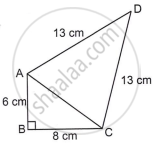
In ΔABC, AB = 6 cm, BC = 8 cm and ∠ABC = 90°. An isosceles ΔACD is described on the base of AC where AD = CD = 13 cm. Find (i) AC and (ii) Area of ABCD.
Advertisements
Solution
Given:
- In ΔABC, AB = 6 cm, BC = 8 cm and ∠ABC = 90°.
- An isosceles triangle ACD is described on base AC, where AD = CD = 13 cm.
- Need to find (i) length AC and (ii) the area of quadrilateral ABCD.
Stepwise Calculation:
i. Finding AC:
Since ∠ABC = 90°, triangle ABC is right angled at B.
Using Pythagoras theorem for right-angled triangle ABC,
`AC = sqrt(AB^2 + BC^2)`
= `sqrt(6^2 + 8^2)`
= `sqrt(36 + 64)`
= `sqrt(100)`
= 10 cm
ii. Finding the area of ABCD:
Area of ABCD = Area of ΔABC + Area of ΔACD
Area of ΔABC: Since ABC is right angled at B
`"Area" = 1/2 xx AB xx BC`
= `1/2 xx 6 xx 8`
= 24 cm2
Area of ΔACD isosceles with AD = CD = 13 cm:
Use Heron’s formula to find the area.
Sides are AC = 10 cm, AD = 13 cm, CD = 13 cm.
Semi-perimeter, `s = (AC + AD + CD)/2`
= `(10 + 13 + 13)/2`
= `36/2`
= 18 cm.
`"Area" = sqrt[s(s - AC)(s - AD)(s - CD))`
= `sqrt(18(18 - 10)(18 - 13)(18 - 13))`
= `sqrt(18 xx 8 xx 5 xx 5)`
= `sqrt(3600)`
= 60 cm2
Therefore, total area of ABCD
= 24 + 60
= 84 cm2
Thus, AC = 10 cm and area of quadrilateral ABCD = 84 cm2.
