Advertisements
Advertisements
Question
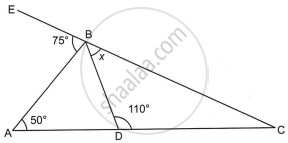
In ΔABC, ∠A = 50°, ∠BDC = 110°, ∠ABE = 75° and ∠DBC = x. Find the angle x and arrange the sides of ΔABC in descending order of length.
Advertisements
Solution
Given:
- ∠A = 50°
- ∠BDC = 110°
- ∠ABE = 75°
- ∠DBC = x
- Find x and arrange sides AB, BC, AC in descending order.
Stepwise calculation:
1. Use the exterior angle property in ΔABD:
∠BDC is the exterior angle for ΔABD at vertex D.
Therefore, ∠BDC = ∠A + ∠ABD.
Given, 110° = 50° + ∠ABD
⇒ ∠ABD = 60°
2. Since ∠ABD consists of two adjacent angles ∠ABE = 75° and ∠DBC = x,
∠ABD = ∠ABE + ∠DBC
60° = 75° + x
⇒ x = 60° – 75°
⇒ x = –15° not possible
The negative value implies ∠ABE and ∠DBC do not lie on the same straight line in that order or that ∠ABE is actually outside of ∠ABD.
3. Instead, consider ΔABE and ΔABC relations.
From the geometry:
∠ABD = 60° as above,
Since ∠ABE = 75° is given,
∠DBC = ∠ABD – ∠ABE = 60° – 15° = 45°.
Hence, x = 45°.
Arranging the sides AC, BC, AB in descending order:
In ΔABC, the angles are then:
- ∠A = 50°
- ∠B = ∠ABE + ∠DBC = 75° + 45° = 120°
- ∠C = 180° – (50° + 120°) = 10°
By the theorem: The side opposite the greater angle is the longer side, so:
- Side opposite ∠B = 120° is AC,
- Side opposite ∠A = 50° is BC,
- Side opposite ∠C = 10° is AB.
Thus, AC > BC > AB.
