Advertisements
Advertisements
Question
In a triangle, show that any side is greater than the difference of the other two sides. [Hint: Construct PS = PR ∴ ∠a = ∠b
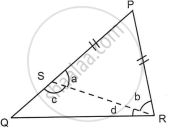
In ΔQSR, ext. ∠a > ∠d ⇒ ∠b > ∠d
In ΔPSR, ext. ∠c > ∠b
∠c > ∠a ⇒ ∠c > ∠d
∴ QR > QS
⇒ QR > PQ – PS
QR > PQ – PR]
Advertisements
Solution
Here’s the step-by-step explanation to show that in a triangle, any side is greater than the difference of the other two sides, based on the provided hint:
Statement:
In a triangle, any side is greater than the difference of the other two sides.
We’ll prove:
For triangle PQR,
QR > |PQ − PR|
Construction (from hint):
Construct triangle PQR.
On side PQ, mark a point S such that PS = PR.
Now join SR and QR.
So in triangle PSR, PS = PR ⇒ It’s isosceles, so:
∠a = ∠b
Step 1:
In triangle QSR,
Exterior angle ∠a > Interior opposite angle ∠d
But since ∠a = ∠b,
⇒ ∠b > ∠d
Step 2:
In triangle PSR,
Exterior angle ∠c > Opposite interior angle ∠b
⇒ ∠c > ∠b
So, from step 1:
∠c > ∠b > ∠d
⇒ ∠c > ∠d
Step 3:
In triangle PQR, comparing ∠c and ∠d:
Since ∠c > ∠d ⇒ side opposite ∠c (which is QR) is greater than side opposite ∠d (which is QS):
⇒ QR > QS
Step 4:
From the construction:
QS = PQ – PS and since PS = PR,
⇒ QS = PQ – PR
Thus, QR > QS = PQ – PR
Final Result:
QR > PQ – PR
So, any side (QR) is greater than the difference of the other two sides (PQ – PR).
Similarly, you can prove:
- PQ > |QR – PR|
- PR > [PQ – QR|
This proves the triangle inequality in difference form.
