Advertisements
Advertisements
Question
In a parallelogram ABCD, diagonal vectors are `bar"AC" = 2hat"i" + 3hat"j" + 4hat"k" and bar"BD" = - 6hat"i" + 7hat"j" - 2hat"k"`, then find the adjacent side vectors `bar"AB" and bar"AD"`.
Advertisements
Solution
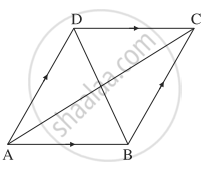
ABCD is a parallelogram.
∴ `bar"AB" = bar"DC", bar"AD" = bar"BC"`
`bar"AC" = bar"AB" + bar"BC"`
`= bar"AB" + bar"AD"` ...(1)
`bar"BD" = bar"BA" + bar"AD" = - bar"AB" + bar"AD"` ...(2)
Adding (1) and (2), we get
`2bar"AD" = bar"AC" + bar"BD" = (2hat"i" + 3hat"j" + 4hat"k") + (- 6hat"i" + 7hat"j" - 2hat"k")`
`= - 4hat"i" + 10hat"j" + 2hat"k"`
∴ `bar"AD" = 1/2(- 4hat"i" + 10hat"j" + 2hat"k")`
`= - 2hat"i" + 5hat"j" + hat"k"`
From (1), `bar"AB" = bar"AC" - bar"AD"`
`= (2hat"i" + 3hat"j" + 4hat"k") - (- 2hat"i" + 5hat"j" + hat"k")`
`= 4hat"i" - 2hat"j" + 3hat"k"`
Notes
The answer in the textbook is incorrect.
