Advertisements
Advertisements
Question
If tan α = `1/7`, sin β = `1/sqrt10`. Prove that α + 2β = `pi/4` where 0 < α < `pi/2` and 0 < β < `pi/2`.
Sum
Advertisements
Solution
Given that tan α = `1/7`
We wish to find tan(α + 2β)
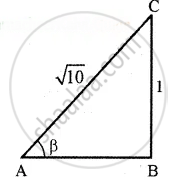
AB2 = AC2 - BC2
AB2 = 10 - 1
AB2 = 9
AB = 3
sin β = `1/sqrt10 = "Opposite side"/"Hypotenuse"`
tan β = `"Opposite side"/"Adjacent side" = 1/3` (Here β is an acute angle)
Now tan 2β = `(2 tan beta)/(1 - tan^2 beta)`
`= (2 (1/3))/(1 - (1/3)^2) = (2/3)/(8/9)`
`= 2/3 xx 9/8 = 3/4`
Consider tan (α + 2β) = `(tan alpha + tan 2 beta)/(1 - tan alpha tan 2beta)`
`= (1/7 + 3/4)/(1 - 1/7 xx 3/4)`
`= ((1 xx 4 + 3xx7)/28)/(1 - 3/28)`
`= (25/28)/(25/28)` = 1
tan (α + 2β) = `tan pi/4 (because tan pi/4 =1)`
∴ α + 2β = `pi/4`
shaalaa.com
Is there an error in this question or solution?
