Advertisements
Advertisements
Question
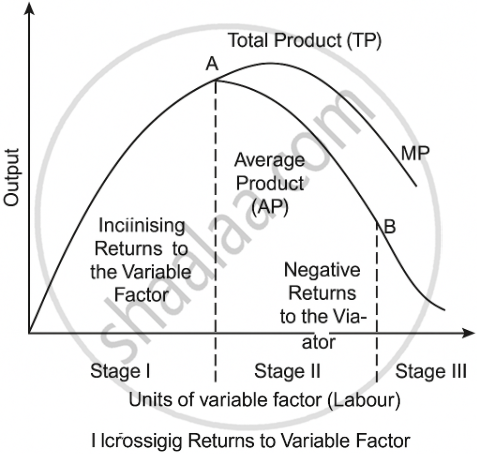
‘If more variable factors are employed with fixed factors, the total product increases at an increasing rate and finally it falls.’ Explain the three stages of the law of variable proportions with the help of TP, AP and MP curves.
Explain
Advertisements
Solution
The law of variable proportions applies to the short run, where at least one factor (like land or capital) is fixed and other factors (like labour) are varied. It explains how output behaves when more units of a variable factor are employed with fixed factors.
- Stage I: Increasing returns to the variable factor
- Total Product (TP) increases at an increasing rate.
- Marginal product (MP) rises.
- Average Product (AP) rises.
- Reason: Better utilization of fixed factors and increasing specialization.
- Stage II: Diminishing returns to the variable factor
- TP increases at a decreasing rate.
- MP falls but remains positive.
- AP also falls after reaching its maximum.
- Reason: Fixed factors become limiting; additional workers have less to work with.
- Stage III: Negative returns to the variable factor
- TP declines.
- MP becomes negative.
- AP continues to fall.
- Reason: Overcrowding and extreme overuse of fixed resources cause output to drop.
shaalaa.com
Is there an error in this question or solution?
