Advertisements
Advertisements
Question
If for a > 0, the feet of perpendiculars from the points A(a, –2a, 3) and B(0, 4, 5) on the plane lx + my + nz = 0 are points C(0, –a, –1) and D respectively, then the length of line segment CD is equal to ______.
Options
`sqrt(41)`
`sqrt(55)`
`sqrt(31)`
`sqrt(66)`
Advertisements
Solution
If for a > 0, the feet of perpendiculars from the points A(a, –2a, 3) and B(0, 4, 5) on the plane lx + my + nz = 0 are points C(0, –a, –1) and D respectively, then the length of line segment CD is equal to `underlinebbsqrt(66)`.
Explanation:
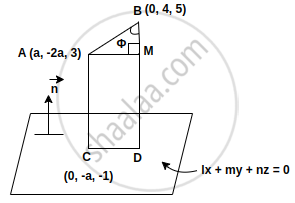
CD = AM ...(i)
In ΔABM: sin`phi = (AM)/|AB|` ...(ii)
Using equation (i) and (ii)
AM = CD = |AB|sin`phi`
CD = `|AB|(sqrt(1 - cos^2phi))`
⇒ CD = `|AB| sqrt(1 - ((vec(AB).vecn)/|vec(AB)|)^2)` ...`(∵ cosphi = (vec(AB).vecn)/(|vecn||vec(AB)|))`
⇒ CD = `sqrt((|vec(AB)|)^2 - (vec(AB).vecn)^2)` ...(iii)
As A(a, –2a, 3) and B(0, 4, 5) then `vec(AB) = vec(OB) - vec(OA) = - ahati + (2a + 4)hatj + 2hatk`
`vec(AB).vecn` = –la + (2a + 4)m + 2n ...(iv)
Since, C(0, –a, –1) lies on plane lx + my + nz = 0,
So, 0l – am – n = 0 ⇒ `m/n = (-1)/a`
From the figure
`vec(AC)||vecn`
`a/l = (-a)/m = 4/n`
m = –l and `m/n = (-a)/4` ...(vi)
Now using equations (v) and (vi)
⇒ a2 = 4
a = ±2
As a > 0, a = 2
Now from equation (vii)
2m + n = 0 [As l2 + m2 + n2 = 1] ...(vii)
∴ m2 + m2 + 4m2 = 1
∴ m2 = `1/6`
∴ m = `+-1/6`
∴ m = `1/sqrt(6)`
Using equation (vii)
n = –2m
n = `(-2)/sqrt(6)`
l = `(-1)/sqrt(6)`
Now from equation (iv)
`vec(AB).vecn = -2((-1)/sqrt(6)) + 8(1/sqrt(6)) + 2((-2)/sqrt(6))`
= `(+2 + 8 - 4)/sqrt(6)`
= `sqrt(6)`
`vec(AB) = sqrt(a^2 + (2a + 4)^2 + (2)^2`
= `sqrt(2^2 + 8^2 + 4^2)`
`|vec(AB)| = sqrt(4 + 64 + 4) = sqrt(72)`
CD = `sqrt((sqrt(72))^2 - (sqrt(6))^2`
CD = `sqrt(72 - 6)`
CD = `sqrt(66)`
