Advertisements
Advertisements
Question
If each edge of a cube is increased by 50%, the percentage increase in its surface area is
Options
50%
75%
100%
125%
Advertisements
Solution
Let,
a →a Initial edge of the cube
A → Initial surface area of the cube
a' → Increased edge of the cube
A' → Increased surface area of the cube
We have to find the percentage increase in the surface area of the cube
Since it’s given that
`a = a+axx50/100`
`= 3/2 a`
We have,
`A' = 6(a)^2`
`= 6 (3/2a)^2 { Since , a' = 3/2 a}`
` = 9/4 (6a^2)`
` =9/4 A`
Percentage increase in surface area,
`=(A'-A)/A xx 100`
`=(9/4 A-A)/A xx 100`
`=(5/4A)/A xx 100`
= 125
Increase in surface area is 125% .
APPEARS IN
RELATED QUESTIONS
Mary wants to decorate her Christmas tree. She wants to place the tree on a wooden block
covered with coloured paper with picture of Santa Claus on it. She must know the exact
quantity of paper to buy for this purpose. If the box has length, breadth and height as 80
cm, 40 cm and 20 cm respectively. How many square sheets of paper of side 40 cm would
she require?
Find the height of a cuboid of volume 100 cm3, whose length and breadth are 5 cm and 4 cm respectively.
Find the surface area of a cuboid whoselength = 3.2 m, breadth = 30 dm, height = 250 cm.
A swimming pool is 20 m long 15 m wide and 3 m deep. Find the cost of repairing the floor and wall at the rate of Rs 25 per square metre.
The dimensions of a room are 12.5 m by 9 m by 7 m. There are 2 doors and 4 windows in the room; each door measures 2.5 m by 1.2 m and each window 1.5 m by 1 m. Find the cost of painting the walls at Rs 3.50 per square metre.
Four cubes, each of edge 9 cm, are joined as shown below :
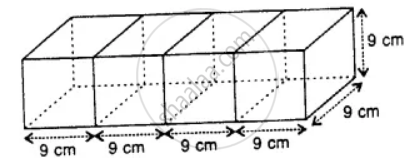
Write the dimensions of the resulting cuboid obtained. Also, find the total surface area and the volume
Find the volume of wood required to make a closed box of external dimensions 80 cm, 75 cm, and 60 cm, the thickness of walls of the box being 2 cm throughout.
The height of a rectangular solid is 5 times its width and its length is 8 times its height. If the volume of the wall is 102.4 cm3, find its length.
The total surface area of a cylinder is 6512 cm2 and the circumference of its bases is 88 cm. Find:
(i) its radius
(ii) its volume
A cylindrical pillar has a radius of 21 cm and a height of 4 m. Find:
- The curved surface area of the pillar.
- cost of polishing 36 such cylindrical pillars at the rate of ₹12 per m2.
