Advertisements
Advertisements
Question
If a, b, c, d are in continued proportion, prove that: (a2 – b2) (c2 – d2) = (b2 – c2)2
Advertisements
Solution
a, b, c, d are in continued proportion
∴ `a/b = b/c = c/d` = k(say)
∴ c = dk, b = ck = dk. k = dk2,
a = bk = dk2. k = dk3
L.H.S. = (a2 – b2) (c2 – d2)
= [(dk3)2 – (dk2)2] [(dk)2 – d2]
= (d2k6 – d2k4) (d2k2 – d2)
= d2k4 (k2 – 1) d2(k2 – 1)
= d4k4 (k2 – 1)2
R.H.S. = (b2 – c2)2
= [(dk2)2 – (dk)2]2
= [d2k2 – d2k2]2
= [d2k2 (k2 – 1)]2
= d4k4(k2 – 1)2
∴ L.H.S. = R.H.S.
APPEARS IN
RELATED QUESTIONS
Check whether the following numbers are in continued proportion.
2, 4, 8
Find the smallest number that must be subtracted from each of the numbers 20, 29, 84 and 129 so that they are in proportion.
Verify the following:
60 : 105 : : 84 : 147
If 48 boxes contain 6000 pens, how many such boxes will be needed for 1875 pens?
The length and breadth of a rectangular field are in the ratio 5 : 4. If the width of the field is 36 m, what is its length?
If a, b, c and d are in proportion, prove that: `(a + c)^3/(b + d)^3 = (a(a - c)^2)/(b(b - d)^2)`
If a, b, c, d are in continued proportion, prove that: `(a^3 + b^3 + c^3)/(b^3 + c^3 + d^3) = a/d`
The quarterly school fee in Kendriya Vidyalaya for Class VI is Rs. 540. What will be the fee for seven months?
Determine if the following ratios form a proportion. Also, write the middle terms and extreme terms where the ratios form a proportion.
2 kg : 80 kg and 25 g : 625 g
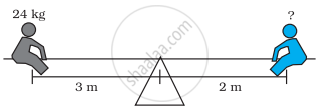
Unequal masses will not balance on a fulcrum if they are at equal distance from it; one side will go up and the other side will go down.
Unequal masses will balance when the following proportion is true:
`("mass"1)/("length"2) = ("mass"2)/("length"1)`

Two children can be balanced on a seesaw when
`("mass"1)/("length"2) = ("mass"2)/("length"1)`. The child on the left and child on the right are balanced. What is the mass of the child on the right?