Advertisements
Advertisements
Question
If A and B are complementary angles, prove that:
cot B + cos B = sec A cos B (1 + sin B)
Advertisements
Solution
Since, A and B are complementary angles, A + B = 90°
cot B + cos B
= cot (90° – A) + cos (90° – A)
= tan A + sin A
= `sinA/cosA + sinA`
= `(sinA + sinAcosA)/cosA`
= `(sinA(1 + cosA))/cosA`
= sec A sin A (1 + cos A)
= sec A sin (90° – B) [1 + cos (90° – B)]
= sec A cos B (1 + sin B)
APPEARS IN
RELATED QUESTIONS
Without using trigonometric tables evaluate the following:
`(i) sin^2 25º + sin^2 65º `
Evaluate.
`(2tan53^@)/(cot37^@)-cot80^@/tan10^@`
Prove that:
`1/(1 + cos(90^@ - A)) + 1/(1 - cos(90^@ - A)) = 2cosec^2(90^@ - A)`
If A and B are complementary angles, prove that:
cot A cot B – sin A cos B – cos A sin B = 0
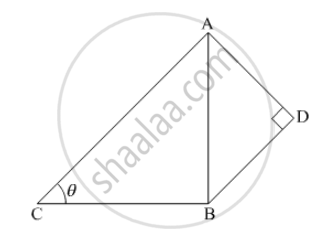
In the following Figure. AD = 4 cm, BD = 3 cm and CB = 12 cm, find the cot θ.
If ∆ABC is right angled at C, then the value of cos (A + B) is ______.
Express the following in term of angles between 0° and 45° :
cosec 68° + cot 72°
Evaluate: `3(sin72°)/(cos18°) - (sec32°)/("cosec"58°)`.
In ∆ABC, cos C = `12/13` and BC = 24, then AC = ?
If sin A = `3/5`, then show that 4 tan A + 3 sin A = 6 cos A.
