Advertisements
Advertisements
Question
If A(4, 3), B(0, 0), and C(2, 3) are the vertices of ∆ABC then find the equation of bisector of angle BAC.
Sum
Advertisements
Solution
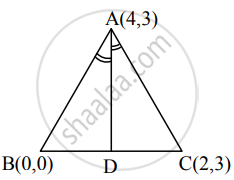
A(4, 3), B(0, 0) and C(2, 3) are the vertices of ΔABC.
Let AD be the bisector of angle BAC.
Then D divides side BC in the ratio AB : AC.
Now, AB = `sqrt((4 - 0)^2 + (3 - 0)^2)`
= `sqrt(16 + 9)`
= `sqrt(25)`
= 5
and AC = `sqrt((4 - 2)^2 + (3 - 3)^2`
= `sqrt(4 + 0)`
= `sqrt(4)`
= 2
∴ D divides BC internally in the ratio 5 : 2, where B(0, 0) and C(2, 3).
∴ by section formula,
D ≡ `((5 xx 2 + 2 xx 0)/(5 + 2), (5 xx 3 + 2 xx 0)/(5 + 2)) = (10/7, 15/7)`
∴ equation of the angle bisector AD is
`(y - 3)/(x - 4) = (15/7 - 3)/(10/7 - 4)`
∴ `(y - 3)/(x - 4) = (15 - 21)/(10 - 28) = (-6)/(-18) = 1/3`
∴ 3y – 9 = x – 4
∴ x – 3y + 5 = 0.
shaalaa.com
Is there an error in this question or solution?
