Advertisements
Advertisements
Questions
How is price and output determined under price discrimination?
Describe determination of price and output under monopoly. Explain with suitable diagram.
Diagram
Explain
Very Long Answer
Advertisements
Solution
Price and output under price discrimination are determined by a monopolist who sells the same product in different markets or to different groups of consumers at different prices. The main goal of the monopolist is to maximize total profit by deciding three things: how much total output to produce, how to divide this output between the different markets, and what price to charge in each market. The process can be broken down as follows:
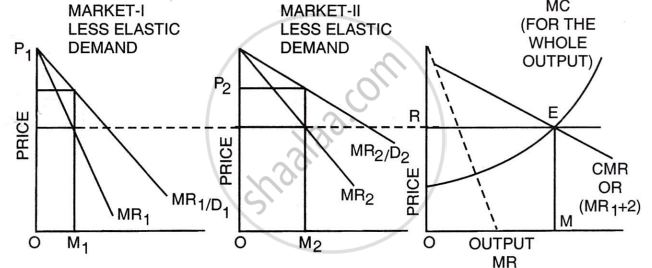
- Markets with Different Elasticities:
- Market I has less elastic demand.
- Market II has more elastic demand.
- Marginal Revenue Curves (MR1 and MR2):
- Each market has its own marginal revenue curve (MR1 for Market I, MR2 for Market II).
- The monopolist faces different marginal revenues in each market due to the different elasticity of demand.
- Composite Marginal Revenue Curve (CMR or ΣMR):
- On the output-marginal revenue (rightmost) graph, the marginal revenue curves of the two markets are combined horizontally to form the composite marginal revenue curve.
- The monopolist produces the total output (OM) where the Marginal Cost (MC) for the whole output equals this combined marginal revenue (point E at which MC = CMR).
- Division of Output Between the Markets:
- The total output OM is divided into OM1 for Market I and OM2 for Market II.
- The monopolist sets marginal revenue equal to marginal cost in both markets, i.e., MR1 = MR2 = MC at output levels corresponding to OM1 and OM2 respectively.
- Price Differences:
- Because Market I is less elastic, the monopolist charges a higher price (P1) with a smaller quantity (OM1).
- In Market II, with more elastic demand, the price is lower (P2) with a larger quantity (OM2).
- Profit Maximization:
- The equilibrium for the monopolist is where MR1 = MR2 = MC for the whole output.
- This allows the monopolist to maximize profits by practicing price discrimination between the two markets.
shaalaa.com
Is there an error in this question or solution?
Chapter 14: Price Output Determination Under Monopoly - TEST QUESTIONS [Page 14.16]
