Advertisements
Advertisements
Question
How does the density of a liquid (or gas) vary with temperature?
Advertisements
Solution
Most of the liquids increase in volume with an increase in temperature, but water shows anomalous behaviour. Water has a maximum volume at 4°C and a maximum density at 4°C.
Actually, when volume increases, density decreases and when volume decreases, density increases.
But water, when cooled from high temperature, contracts up to 4°C because volume decreases and expands when cooled further below 4°C and hence the density of water increases when it is cooled up to 4°C while decreases when cooled further below 4°C. In other words, the density of water is maximum at 4°C equal to 1 g/cm3 or 1000 kg/m3.
APPEARS IN
RELATED QUESTIONS
The density of a liquid decreases with increase in its temperature.
A given quantity of a liquid is heated. Which of the following quantity will vary and how?
(a) mass, (b) volume and (c) density
A balloon filled with hydrogen rises in air. Explain the reason.
The density of air is 1.28 g/Iitre. Express it in g cm-3
The density of air is 1.28 g/Iitre. Express it in kg m-3
The dimensions of a hall are 10 m × 7 m × 5 m. If the density of air is 1.11 kg m-3, find the mass of air in the hall.
State true or false. If false, correct the statement.
A substance which contains less number of molecules per unit volume is said to be denser.
Two spheres of same size are made from copper and iron respectively. Find the ratio between their masses (Density of copper is 8,900 kg/m and iron is 7,800 kg/m3 ).
A liquid having a mass of 250 g fills a space of 1000 cc. Find the density of the liquid.
Questions based on Higher Order Thinking Skills:
There are three spheres A, B, C as shown below. Sphere A and B are made of same material. Sphere C is made of a different material. Spheres A and C have equal radii. The radius of sphere B is half that of A. Density of A is double that of C.
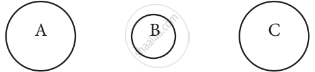
Now answer the following questions.
- Find the ratio of masses of spheres A and B.
- Find the ratio of volumes of spheres A and B.
- Find the ratio of masses of spheres A and C.
