Advertisements
Advertisements
Questions
How does cognitive dissonance help in attitude change?
How cognitive dissonance changes attitudes?
Discuss how cognitive dissonance helps in changing one’s attitude.
Advertisements
Solution 1
Cognitive dissonance creates psychological discomfort when a person’s behaviour conflicts with their existing attitude or belief. This discomfort motivates the individual to reduce the inconsistency and regain mental balance.
How It Leads to Attitude Change:
- Motivation to Reduce Discomfort: People feel uneasy when their actions contradict their beliefs, prompting them to change their attitude to match their behaviour.
- Adjustment of Beliefs or Attitudes: Instead of changing behaviour (which may be difficult), people often adjust their attitude to justify their actions.
- Example: A person believes wasting food is wrong but throws food away. To reduce dissonance, they may change their attitude by thinking, “It was just a small amount” or “Everyone wastes food sometimes.”
Solution 2
Leon Festinger’s (1957) cognitive dissonance theory remains the most influential in understanding cognitive consistency. Cognitive dissonance theory assumes a discrepancy between cognitive elements or attitudes and behaviours. For example, cognitive dissonance occurs when a person smokes despite knowing that it is harmful to their health and can lead to lung cancer. Cognitive dissonance is a key factor in influencing attitude change. The contradiction creates pressure to make the pieces harmonious. Dissonance theory addresses contradictions between people’s attitudes and behaviour.
Dissonance is defined as an aversive motivational state that results when some behaviour one engages in is inconsistent with one’s attitudes. Dissonance is often triggered by attitudes and behaviours that are important to the self. Dissonance can trigger psychological attention and unpleasant emotions, leading to pressure to diminish or eliminate it. Reducing restores consistency or consonance. There are four ways of achieving this consonance.
- One way is to change our behaviour in some way, but this is frequently impractical.
- In order to avoid frequently changing their perspective, people occasionally trivialise the dissonance. As an illustration, smoking does not necessarily result in cancer.
- Nonetheless, people alter their attitude to overcome the contradiction between their behaviour and attitude.
- By changing or modifying knowledge that may reduce discomfort or dissonance.
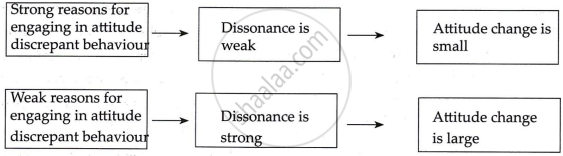
However, many people may not reduce the dissonance. Reduce the bad feelings linked with it. Positive self-evaluation involves focusing on one’s own positive traits. For example, although smoking, I have a healthy physique and experience fewer health issues. According to social scientists, individuals who act counter to their attitudes for significant reasons may not experience dissonance or discomfort. They can defend their conduct. As a result, there is no noticeable shift in attitude. Acting against one’s attitude, even for minor reasons, can lead to cognitive dissonance. As a result, the likelihood of changing one’s attitude increases. This is known as the less-leads-to-more effect.