Advertisements
Advertisements
Question
How does an electric fan managed to throw so much air when it is switched on?
Advertisements
Solution
An electrical fan comprises of three blades and a whirling motor. The moment it is switched on. the motor starts and begins to rotate, forcing the blades to move in circular movement. this generates a lot of pressure, which forces the air downwards in all directions.
RELATED QUESTIONS
Answer of these question in a short paragraph (about 30 words).
Why was Margie doing badly in geography? What did the County Inspector do to help
her?
Match the meanings with the words/expressions in italic, and write the appropriate
meaning next to the sentence.
The boy hid behind the door, not moving a muscle.
Bill Bryson “ached to be suave”. Is he successful in his mission? List his ‘unsuave’ ways.
Why does he break down in tears after the fire?
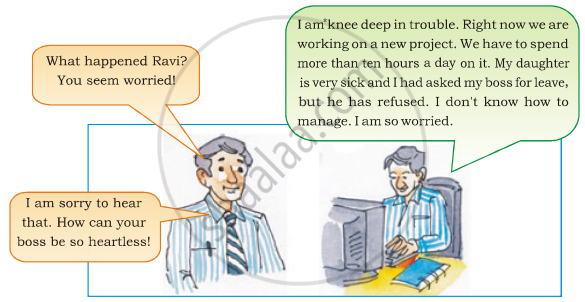
Read the following conversation between two friends.
Subject Verb Agreement.
A verb must be in the same number and person as its subject e.g.
(a) A man and his wife have lived here since January 2009.
(b) Arun, a great scholar, is dead.
(c) Either James or Peter is to be promoted.
( d) The horse as well as its rider was hurt by the fall.
(e) Not only India, but also the whole world recognises Gandhiji's
achievements
(f) Eachman was rewarded.
(g) Every tree has been saved.
(h) The Adventures of Tom Jones is a great novel.
Bangle sellers are we who bear
Our shining loads to the temple fair...
Who will buy these delicate, bright
Rainbow-tinted circles of light?
Lustrous tokens of radiant lives,
For happy daughters and happy wives.
Read the lines given above and answer the question that follow.
Explain with reference to context.
"My father lived at Blenheim then,
Yon little stream hard by;
They burnt his dwelling to the ground,
And he was forced to fly;
So with his wife and child he fled,
Nor had he where to rest his head.
"With fire and sword the country round
Was wasted far and wide,
And many a childing mother then,
And new-born baby died;
But things like that, you know, must be
At every famous victory;
Read the lines given above and answer the question that follow.
What does Kasper’s attitude signify?
When there was a strong wind, the pine trees made sad, eerie sounds that kept most people to the main road. But Mr. Oliver was not a nervous or imaginative man. He carried a torch – and on the night I write of, its pale gleam, the batteries were running down – moved fitfully over the narrow forest path. When its flickering light fell on the figure of a boy, who was sitting alone on a rock, Mr. Oliver stopped.
Boys were not supposed to be out of school after seven P.M. and it was now well past nine. What are you doing out here, boy, asked Mr. Oliver sharply, moving closer so that he could recognize the miscreant.
Read the extract given below and answer the question that follow.
Whom did Mr Oliver meet in the forest?
Sibia sprang.
From boulder to boulder she came leaping like a rock goat. Sometimes it had seemed difficult to cross these stones, especially the big gap in the middle where the river coursed through like a bulge of glass. But now she came on wings, choosing her footing in midair without even thinking about it, and in one moment she was beside the shrieking woman. In the boiling bloody water, the face of the crocodile, fastened round her leg, was tugging to and fro, and smiling. His eyes rolled on to Sibia. One slap of the tail could kill her. He struck. Up shot the water, twenty feet, and fell like a silver chain. Again! The rock jumped under the blow. But in the daily heroism of the jungle, as common as a thorn tree, Sibia did not hesitate. She aimed at the reptile’s eyes. With all the force of her little body, she drove the hayfork at the eyes, and one prong went in—right in— while its pair scratched past on the horny cheek. The crocodile reared up in convulsion, till half his lizard body was out of the river, the tail and nose nearly meeting over his stony back. Then he crashed back, exploding the water, and in an uproar of bloody foam he disappeared. He would die. Not yet, but presently, though his death would not be known for days; not till his stomach, blown with gas, floated him. Then perhaps he would be found upside down among the logs at the timber boom, with pus in his eye. Sibia got arms round the fainting woman, and somehow dragged her from the water.
Read the extract given below and answer the question that follow.
What was the reaction of the crocodile when he saw Sibia?
How long does it take for a grub to become a complete ant?
Answer the following question
How did Gopal get inside the palace to see the king after he had bought the fish?
Did she repent her hasty action? How does she show her repentance?
Why was the crocodile’s wife annoyed with her husband one day?
What did the monkey do as he reached the tree?
Why does Mary O’ Neill call English “a wonderful game’?
Answer the following question.
What was the villagers’ reaction when the aunt explained her case to them?
Name the young lovers whose lives ended tragically because of a misunderstanding caused by the appearance of a lion.
Read the following passage carefully and answer the questions that follow:
|
That huge bell never stopped ringing. It got us out of bed, it summoned us for meals, it rang between class periods, it sent us unwillingly to bed. One morning it failed to ring, or rather, there was no bell to ring. Someone had removed it, and it wasn't found till late in the afternoon. What a glorious day! As there was no bell to rouse us, everyone got up late, and there was no morning PT. Some of us missed breakfast too. The teachers got confused and mixed up their classes. How could the school manage without it? Confusion reigned. Of course, no one owned up. It could have meant expulsion. Some suspicion fell on the Sports Captain because of our aversion to morning PT, but nothing could be proved. No one was very anxious to find the bell - we were quite happy without it - but it was finally discovered hanging from a branch of one of the trees. ‘It may have been Mr. Sharma,' surmised Brian. Mr. Sharma, our Maths teacher, was known to walk in his sleep. And sleepwalkers did funny things sometimes. ‘It could be Mool Chand himself,’ suggested Cyrus Satralkar. Mool Chand was the school chowkidar, who also had the job of banging the brass bell at appointed times. ‘Why would he throw it away?’ ‘He must be as fed up with ringing it as we are of hearing it.’ This was my theory. ‘Perhaps he wants a rise in salary.’ The identity of the culprit remained a mystery. Happily, the senior Hockey team went on a winning spree against all corners, and our month-end exits were restored. But soon there was another sensation. A girl was admitted to our class! The boys were scandalized. No girl had ever studied in our school before. We protested. ‘What’s the problem?’ asked Mr. Knight, our class master. ‘Haven’t you seen a girl before?’ ‘But - but. Sir ...’ Tata was our spokesman. ‘How will we concentrate on our studies?’ ‘When did you ever concentrate on your studies, Tata?’ ‘Are we going co-ed, sir?’ Adams wanted to know. ‘Not at all,’ said Mr. Knight. ‘This is a special case. She is the school accounts manager’s daughter, and he can’t afford the Girls school fees. So, I’m sure you’ll make her feel very welcome.’ The accountant was a popular man who also ran the school’s tuck shop and allowed most of us a certain amount of credit. All our objections faded away. At first, Sunita, our new entrant, was a bit of a distraction because, although she was very shy and demure, she had lovely curly hair, bright eyes, pink cheeks and a smile for everyone. All the boys were very polite and attentive to her and Brian in particular was always ready to help her. |
- For each word given below choose the correct meaning (as used in the passage) from the options provided: (3)
- summoned (line 1)
- totalled
- ordered
- requested
- shout
- aversion (line 10)
- hatred
- fear
- politeness
- creation
- restored (line 25)
- helped
- returned
- permit
- victory
- summoned (line 1)
- Answer the following questions briefly in your own words.
- Why did no one confess to having removed the missing bell? (1)
- Why did suspicion fall on the Sports Captain? (2)
- What made Brian think that it was Mr. Sharma? (2)
- Which sentence in the passage tells you that Mr. Knight thought poorly of Tata’s academic performance? (2)
- Why was the accountant a popular man? (2)
- In not more than 50 words describe the effects of the lost bell. (8)
Why does Shane Koyczan begin the poem, Beethoven, with the word “Listen”?
