Advertisements
Advertisements
Question
How do we determine whether the demand for a particular commodity is elastic or inelastic?
Advertisements
Solution
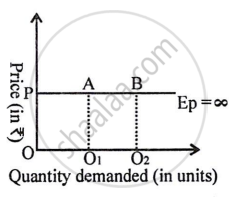
The commodity is said to be perfectly elastic when:
Perfectly elastic: Demand is said to be completely elastic when a little change in price causes an indefinitely large change in the amount required of a good. A minor increase in the seller's price will reduce the demand for the commodity to zero, whereas a slight decrease in the price will result in such a large increase in demand for products that no single seller will be able to meet the demand at the decreased price. In such cases, the demand curve is a straight line parallel to the X-axis.
APPEARS IN
RELATED QUESTIONS
What is unitary elastic demand? Draw a diagram to illustrate it.
For the following list of goods state whether the demand is elastic or inelastic. Give reasons:
Matchboxes
Mention the degree of price elasticity of demand for the following goods:
Medicine
Mention the degree of price elasticity of demand for the following goods:
School uniform
Study the statement given below and state whether demand will be elastic or inelastic, citing reasons for your answer.
Demand for cigarettes by a habitual smoker.
Indicate the degree of elasticity demand of the following demand curves.

What is meant by unitary elastic demand?
The value of price elasticity of demand is 0.8. Is demand elastic or inelastic? Give reason.
State whether the price elasticity of demand is inelastic, relatively elastic, highly elastic or highly inelastic. Give reasons to support your answer.
demand for school uniform
State whether the price elasticity of demand is inelastic, relatively elastic, highly elastic or highly inelastic. Give reasons to support your answer.
Demand for diesel and petrol
