Advertisements
Advertisements
Question
How do non-green plants such as fungi and bacteria obtain their nourishment?
Advertisements
Solution
Non-green plants such as fungi and bacteria obtain their nourishment from decaying organic matter in their environment, which comes from dead animals and plants. Thus they are dependent on photosynthesis.
RELATED QUESTIONS
Given below is an experiment setup to demonstrate a particualr tropic movement in germinating seeds. Study the diagram and answer the questions that follow :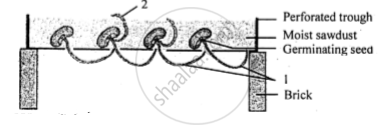
(ii) Name the tropic movement shown by part 1.
The diagram given below represents an experiment to prove the importance of a factor in photosynthesis. Answer the questions that follow :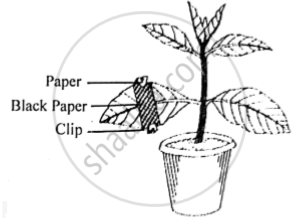
Explain the process of Photosynthesis.
Mention two ways in which photosynthesis is useful to life.
Are the following statement true or false? Give a reason in support of your answer.
If you immerse a leaf intact on the plant in ice cold water, it will continue to photosynthesise in bright sunshine.
Complete the following sentence with appropriate word:
AIIP stands for ____________.
Write the functional activity of the following structure:
Stroma
Which one of the following is a primary producer?
Oxygen is produced at what point during photosynthesis?
During photosynthesis, plants exhale ______.
Distinguish between the following pairs on the basis of the word indicated in the bracket ( ).
Producers and Consumers (organisms)
