Advertisements
Advertisements
Question
How did father make an attempt to save the Cat for the Second time?
Advertisements
Solution
For the second time, instead of climbing up the ladder, he swung himself on a branch.
RELATED QUESTIONS
Based on your reading of the story answer the following question by choosing the correct option:
The author says that Duke ‘knew his job’ The job was __________
Based on your reading of the story, answer the following question by choosing the correct options.
The author and his friend Trower fled from the scene as _____
Look at the passage below and study how the personal pronouns refer to different people.
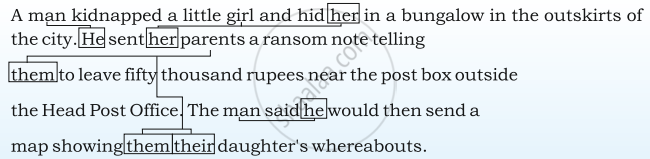
Understanding determiners.
Determiners are words that are used in front of nouns to indicate whether you are
referring to something specific or something of a particular type.
Singular nouns always need a determiner. In plural nouns, the determiner is
optional. Determiners may or may not be used with uncountable nouns depending
on context.
There are about 50 different determiners in the English language which include:
Articles: a, an, the
Possessives: my, your, our, their, his, hers, whose, etc.
Demonstratives: this, that these, those, which, etc.
Quantifiers: few, a few, many, much, each, every, some, any, etc.
Number: one, two, three, twenty, forty, etc.
Ordinals: first, second, last, next, etc.
Determiners are used
• to state the unit/ number of people, things or other nouns.
• to state possessives.
• to specify someone or something.
• to state how things or people are distributed.
• to state the difference between nouns.
Determiners can be classified under the following categories:
| EXAMPLES | ||
| MULTIPLIERS | double, twice, three times... | We want double portions. |
| FRACTIONS | half, a third, two fifths ..... | I drove at half speed. |
| INTENSIFIERS | What! Such! | Such impudence! |
| QUANTIFIERS | all, both, most | I like most people. |
| ARTICLES | a, an, the | Get a book from the shelf. |
| DEMONSTRATIVES | this, that, these, those, another, other | That tree is in another garden. |
| DISTRIBUTIVES | each, every, either, neither | I have a gift for each person. |
| POSSESSIVES | ||
| (i) PRONOMINAL | my, your, his, her, its, our, your, their | You can borrow Kim's video. |
| (ii) NOMINAL | Renata's, Adam's, People's ... | You can borrow my video. |
| INTERROGATIVES | What? Which? Whose? | Whose book is that? |
| QUANTIFIERS | some, any, no | I have no problem with them. |
| CARDINAL NUMBERS | one, two, three hundred ..... | Two heads are better than one. |
| ORDINAL NUMBERS | first, fewer, much, more, less, least ......... . | It was my first tennis match. |
| QUANTIFIERS | ||
| (i) SIMPLE | few, fewer, much, more, less, least ........... . |
I have few pals; Kim has more. |
| (ii) COMPOUND | a little, a lot of, a great deal of .... |
I have lots of time to spare. |
Teacher/Students will read out an interview between a radio jockey and a pilot. (Page 174)
Did you notice the phrases used by debaters to emphasise/negate certain points? Given below are certain expressions that might be used by debaters.
1. I'd like to raise a/the question/ argue ___
2. In my opinion ___
3. Nothing could be more illogical than ____
4. I feel very strongly that ___
5. I would like to draw attention to ___
6. I fail to understand ____
7. I thinkyou are being unreasonable in suggesting ___
8. I submit that ____
9. My first/ next/ final argument against/ in favour of ____
10. I support the motion that_____
11. My knowledgeable opponent has submitted that ____
12. May l ask ___
13. I strongly oppose/ support the view that ___
14. On the contrary ___
15. It is unrealistic to say that ____
16. I disagree ____
17. I firmly reject ____
18. I wholeheartedly oppose/ support____
Bangle sellers are we who bear
Our shining loads to the temple fair...
Who will buy these delicate, bright
Rainbow-tinted circles of light?
Lustrous tokens of radiant lives,
For happy daughters and happy wives.
Read the lines given above and answer the question that follow.
Who is the speaker in the poem?
It was a summer evening,
Old Kaspar's work was done,
And he before his cottage door
Was sitting in the sun,
And by him sported on the green
His little grandchild Wilhelmine.
She saw her brother Peterkin
Roll something large and round,
Which he beside the rivulet
In playing there had found;
He came to ask what he had found,
That was so large, and smooth, and round.
Read the lines given above and answer the question that follow.
Explain with reference to context.
He looked at me very blankly and tiredly, and then said, having to share his worry with someone, “The cat will be all right, I am sure. There is no need to be unquiet about the cat. But the others. Now what do you think about the others?”
“Why they’ll probably come through it all right.”
“You think so?”
“Why not,” I said, watching the far bank where now there were no carts.
“But what will they do under the artillery when I was told to leave because of the artillery?”
“Did you leave the dove cage unlocked?” I asked.
“Yes.”
“Then they’ll fly.”
“Yes, certainly they’ll fly. But the others. It’s better not to think about the others,” he said.
Read the extract given below and answer the question that follow.
Which animal is the old man least concerned about?
From the third paragraph pick out
(i) words associated with cries of birds,
(ii) words associated with noise,
(iii) words suggestive of confusion and fear.
How does Tilloo manage to find his way to the ‘forbidden passage’?
Now write the story in your own words. Give it a title.
What happened when the wicked old farmer sprinkled ash over the cherry tree?
How did Tilloo’s father manage the ugly situation when Tilloo was caught impersonating?
Complete the following sentence
It is mysterious because ______
What was Patrick’s chief interest?
Multiple Choice Question:
What does the poet want to say through the poem?
Answer the question.
How does the poet plan to find out? What will he do once he finds out?
Why did the speaker find the old banyan tree exclusively his own?
What are some of the particular habits of the mongoose and the camel?
