Advertisements
Advertisements
Question
Homolytic fission of covalent bond leads to the formation of ______.
Options
electrophile
nucleophile
Carbo cation
free radical
Advertisements
Solution
Homolytic fission of covalent bond leads to the formation of free radical.
APPEARS IN
RELATED QUESTIONS
For the following reactions
- \[\ce{CH3CH2CH2Br + KOH → CH3 – CH = CH2 + KBr + H2O}\]
- \[\ce{(CH3)3CBr + KOH → (CH3)3COH + KBr}\]
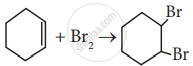
Which of the following statement is correct?
Decreasing order of nucleophilicity is ______.
Which of the group has highest + I effect?
Which of the following species does not exert a resonance effect?
Which of the following species does not acts as a nucleophile?
The geometrical shape of carbocation is ______.
Write a short note on resonance.
Write a short note on hyperconjucation.
What is electrophiles? Give a suitable example.
Show the heterolysis of a covalent bond by using curved arrow notation and complete the following equation. Identify the nucelophile.
\[\ce{CH3 – O – CH3 + HI →}\]
