Advertisements
Advertisements
Question
Given a + b + c + d = 0, state whether the following statement is correct or incorrect:
b + c must lie in the plane of a and d if a and d are not collinear, and in the line of a and d, if they are collinear.
Options
Correct
Incorrect
Advertisements
Solution
This statement is Correct.
Explanation:
∴ a + b + c + d = 0
∴ a + c = (b + d)
∴ b + d = (a + c)
If a + d are not collinear, then a + d will be in the plane of a and d.
Therefore, b + d = -(a + d) will also be in the plane of a + d. If a and d are collinear, then -(a + d) will also be collinear with a and d; therefore, b + c will also be parallel to a and d.
APPEARS IN
RELATED QUESTIONS
Establish the following vector inequalities geometrically or otherwise:
- | a+b | ≤ |a| + |b|
- |a + b| ≥ | |a| - |b| |
- |a - b| ≤ |a| + |b|
- |a-b| ≥ | |a| - |b| |
When does the equality sign above apply?
Given a + b + c + d = 0, state whether the following statement is correct or incorrect:
The magnitude of (a + c) equals the magnitude of (b + d).
Given a + b + c + d = 0, state whether the following statement is correct or incorrect:
The magnitude of a can never be greater than the sum of the magnitudes of b, c, and d.
For two vectors A and B, A + B = A − B is always true when
- |A| = |B| ≠ 0
- A ⊥ B
- |A| = |B| ≠ 0 and A and B are parallel or anti parallel
- When either |A| or |B| is zero
If `vec"A" = (2hat"i"+3hat"j"- hat"k")`m and `vec"B" = (hat"i" + 2hat"j"+ 2hat"k")` m. The magnitude of component of vector `vec"A"` along vector `vec"B"` will be ______ m.
What is the essential condition required for two or more vectors to be added or subtracted?
When two anti-parallel vectors are combined, the direction of the resultant is:
Multiple engines pushing an aircraft forward is an example of:
A swimmer attempts to swim upstream. The swimmer can swim at 4 m/s in still water, but the current flows downstream at 1.5 m/s. What is the swimmer's net velocity relative to the ground?
The process of finding the resultant of two or more vectors is called ______.
The resultant of two vectors will be maximum, if they are ______.
The resultant of two vectors will be minimum, if they are ______.
The process of finding the components of a given vector is called as ______.
If more than three forces are acting on a heavy rigid body such that the body is in balanced state, then all the forces are ______.
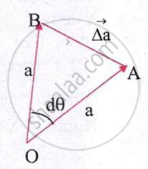
A vector \[\vec a\] is turned without a change in its length through a small angle dθ. The value of |Δ\[\vec a\]| and Δa are respectively