Advertisements
Advertisements
Question
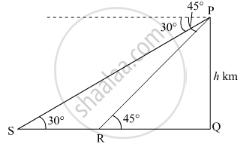
From the top of a hill, the angles of depression of two consecutive kilometer stones due east are found to be 45° and 30° respectivly. Find the height of the hill ?
Advertisements
Solution
Let PQ be the hill of height h km. Let R and S be two cosecutive kilometre stones, so the distance between them is 1 km.
Let QR = x km
\[In ∆ PQR, \]
\[ \tan456^o = \frac{PQ}{QR}\]
\[ \Rightarrow 1 = \frac{h}{x}\]
\[ \Rightarrow h = x . . . (i)\]
\[In ∆ PQS, \]
\[ \tan30^o = \frac{PQ}{QS}\]
\[ \Rightarrow \frac{1}{\sqrt{3}} = \frac{h}{x + 1}\]
\[ \Rightarrow \sqrt{3}h = x + 1 . . . (ii)\]
From equation (i) and (ii) we get,
\[\sqrt{3}h = h + 1\]
\[ \Rightarrow h\left( \sqrt{3} - 1 \right) = 1\]
\[ \Rightarrow h = \frac{1}{\sqrt{3} - 1} = \frac{\sqrt{3} + 1}{\left( \sqrt{3} - 1 \right)\left( \sqrt{3} + 1 \right)}\]
\[ \Rightarrow h = \frac{\sqrt{3} + 1}{2} = \frac{2 . 73}{2} = 1 . 365 km\]
\[ \Rightarrow h\left( \sqrt{3} - 1 \right) = 1\]
\[ \Rightarrow h = \frac{1}{\sqrt{3} - 1} = \frac{\sqrt{3} + 1}{\left( \sqrt{3} - 1 \right)\left( \sqrt{3} + 1 \right)}\]
\[ \Rightarrow h = \frac{\sqrt{3} + 1}{2} = \frac{2 . 73}{2} = 1 . 365 km\]
Hence, the height of the hill is 1.365 km.
shaalaa.com
Is there an error in this question or solution?
